|
![]() Cooking Ingredients
|
|||||||||||||||||||||||||||||||||||||||||||
Any number of Asian stir-fries begin with garlic cooked in oil. But if you add chilies,
kaffir lime leaves, sugar, and fish sauce, a stir-fry takes on a delicious, unmistakably
Thai flavor. The result is an explosion of salty, spicy, sweet, and sour flavors that
sparkle with personality yet all harmonize on the plate. Indeed, the art of Thai cooking
is combining ingredients at opposite ends of the flavor spectrum--chile paste and coconut
milk, palm sugar and lime juice--and balancing them to create vibrantly flavored food.
To create such dishes at home, stock your pantry with some basic Thai flavorings. Once you understand the main players, you can use them to cook authentic Thai food or to give your own cooking a taste of Thailand. Fish sauce--the salt of Thai cuisine. Fish sauce, called nam pla in Thai
or nuoc mam in Vietnamese, is used much like salt or soy sauce as Like olive oil, there are several grades of fish sauce. High-quality fish sauce, which is the first to be drained off the fermented fish, is usually pale amber, like clear brewed tea. Because it has a more delicate and balanced flavor, I use a premium-grade fish sauce, such as Three Crabs or Phu Quoc brands, in my dipping sauces. For cooking, I'll use stronger-flavored, lower-grade brands, such as Squid or Tiparos, which are made from a secondary draining. Whichever grade I buy, I prefer it in a glass bottle; I find that fish sauces bottled in glass taste better and last longer than those packaged in plastic. For heat, try fresh and dried chiles and ground chile pastes. If you like hot food, add chiles and chile paste to just about everything, as the Thais do. I start all my Thai stir-fries by foaming some little fresh bird chiles in hot oil with garlic. If you can't find fresh Thai chiles, use fresh serranos or substitute dried. Chile paste, usually a mix of chiles, garlic, salt, and oil, is the base for many Thai soups, salad dressings, dipping sauces, and stir-fries.
Coconut milk and palm sugar are the most common sweet ingredients. The sweet element found in most Thai dishes isn't cloying. Instead, it balances the heat and counters the sour notes. Coconut milk, often added to curries, stews, and stir-fries, tones down the heat with its creamy sweetness. Palm sugar, made from the sap of various palm trees, comes packaged in plastic jars or as round cakes. It has a caramel flavor that enhances the salty and sour flavors of a dish. If you can't find palm sugar, substitute light brown or granulated white sugar, increasing the amount called for by about 20 percent.
Acidic ingredients add vibrancy. Thai cooks use great amounts of tart ingredients, such as lime juice and tamarind juice (made by soaking tamarind pulp in water), to wake up the taste buds. Lemongrass and kaffir lime leaves give a dish a refreshing, lingering lift. Lemongrass, the most popular herb used in Thailand, is a tall, scallion-like stalk that has a subtle lemony and citrusy flavor and fragrance. Before using, peel away the tough outer layers and crush or chop the stalk to release its flavor. Kaffir lime leaves impart a most intense floral and citrus flavor and are almost required in Thai curries. Lime zest, while not the same, will give the dish a similar refreshing citrusy flavor.
Bright, fresh herbs are aromatic finishes. There's another group of ingredients
that further enhances all these basic flavors--the aromatics. Fresh herbs, such as basil,
mint, and cilantro, are added to finished dishes
The shoots of the bamboo are cut when they have grown about 15 cm (6 inches) above the ground. They need to be peeled and the inner, white part boiled for 30 minutes in water. However, the canned variety needs to be boiled for only 10 minutes and may be used immediately in soups or curries. Canned bamboo shoots, once fridge, if the water is renewed every day. BASIL AND HOLY BASIL Hindus believe that basil is sacred and they like to plant it in religious sanctuaries. The variety of basil they use is called holy basil and it has a spicy flavour. This is more difficult to find in the West than sweet basil, but pepper or finely chopped chilli can be added to the sweet variety to compensate. Both types of basil are used a lot in Thai cooking. BEANCURD This is a soy bean extract to which a setting agent has been added. Soft beancurd is white, and is used extensively in Chinese dishes. It is available in most oriental shops, and is usually sold in pieces 7,5 cm (3 inches) square. Hard or dry beancurd is made by compressing soft beancurd. Beancurd is available in many other forms - fried, fermented, etc. BEANSPROUTS The sprouts of the soy or mung bean are crunchy and tender. They can be grown at home, but they are easy to find in most places nowadays. The canned variety is not a very good substitute but beansprouts can be replaced by other fresh vegetables, finely sliced, if necessary. BERGAMOT (Makroud) Also known as kaffir lime, this plant is found everywhere in Thailand and people often grow it at home. The leaves have a delicate flavour, slightly lemony, which goes equally well with curries and seafood dishes. The fruit has a bumpy dark green rind with a concentration of aromatic oils and the aroma of lemon. Sometimes the juice of this fruit is used in Thai dishes instead of lime, or vice versa. The skin is also used in many Thai dishes, especially curries, and can be replaced by grated lime skin if necessary. CARDAMOM The queen of spices, cardamom has been used since ancient times. Produced mostly in India and Sri Lanka, it also grows in south-eastern Thailand near Cambodia. The aromatic pods can be green, white or black and they all contain a number of small seeds. The pods and seeds are used in different types of sweet or savoury Thai dishes, especially in curries. Powdered cardamom is readily available but it is better to grind your own freshly if possible. Young celery leaves make an attractive garnish which enhances the flavour of the food at the same time. Many different varieties of chillies are used in Thailand but the most common is 7.5-10 cm (3-4 inches) long and can be red, green or yellow when fresh. Dried, it is red. Another popular chilli in Thai cooking is tiny, green and extremely fiery. The seeds are the hottest part of the chilli so if you want to keep the flavour, with out the heat, slit open the chillies and discard the seeds. Dried chillies should be soaked in hot water for 10 minutes before grinding. The Thai use chillies in almost every conceivable way - fresh, dried, whole, chopped, crushed or sliced into rings. Just a few words of caution, always wash your hands carefully after handling chillies and do not touch your eyes or mouth, or they will suffer from a burning sensation. They are sold in most oriental food stores around the world. Be sure to shake the tin well before opening to use. The round, beige seeds are added to curries and vegetables. The roots are crushed with garlic to flavour meat and are often added to soups, especially beef soups. The leaves are used extensively as a garnish. GARLIC GINGER Fresh lemongrass can be kept, loosely wrapped, in the bottom part of your refrigerator for up to one week. Please note that lemon is not a substitute for the unique flavours of lemongrass. LIME LEAF MINT RICE, THAI JASMINE Widely available in supermarkets, it is much favoured by Thai cooks and chefs. The taste of jasmine is not quite perceptible, but you sense that the rice is pleasingly different. And there is a difference, however subtle. RICE NOODLES TAMARIND Experiment with Thai flavors
--Mai Pham is the chef-owner of Lemon Grass Restaurant & Cafe in Sacramento, California. She wrote The Best of Vietnamese & Thai Cooking. Photos: Scott Phillips. From Fine Cooking #31, pp. 72-73. |
||||||||||||||||||||||||||||||||||||||||
Curries
Kaeng - curry
Kaeng
mat sa man - a rich beef curry with peanuts, not spicy
Kaeng ka ri - a mild
flavored Indian type curry made with potatoes and most commonly chicken though
sometimes other meats are used
Kaeng kai - chicken curry
Kaeng nua -
beef curry
Kaeng pla duk - catfish curry
Kaeng som - fish and vegetable
curry
Kaeng penang - spicy dry curry
Kaeng kio waan - green curry
Soups
Kaeng chut - a mild flavored soup made of vegetables and/or shrimp,
chicken and pork
Kaeng chut wun sen - the same as kaeng chut but with
shredded jelly
Kaeng liang - a typical Thai style vegetable soup
Tom yam
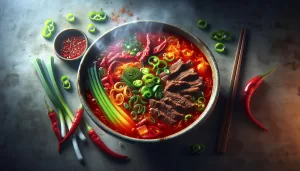
- a chili hot and sour soup made with pork, shrimp, beef, chicken or fish
Tom - indicating that a dish is boiled
Khao tom mu - a mild rice soup
flavored with pork
Khao tom pla - a mild rice soup flavored with fish
Khao tom kung - a mild rice soup flavored with shrimp
Tom khlong -
salted fish boiled with tamarind and onions
Pet tun - steamed duck soup
Khao phot - corn soup
Hu cha lam sai pu - shark fin soup with crab meat
Egg Dishes
Khai - egg
Khai luak - soft boiled egg
Khai tom - hard
boiled egg
Khai dao - fried egg
Khai tot - omelette
Khai tot sai mu
- omelette filled with pork
Khai yat sai - omelette filled with meat, onions
and sugar peas
Po pia - an egg roll containing bean sprouts, pork and crab
meat (not fried)
Po pia tot - an egg roll containing bean sprouts, pork,
crab meat (fried)
Fried Dishes
Khao - rice
Khao phat - fried rice
Pla tot - fried fish
Kai tot - fried chicken
Kai phat phrik - fried
chicken and chillies
Kai yang - roasted chicken
Kung tot krob - crisp
fried prawns
Priao wan - sweet and sour pork with vegetables
Phak kung
phat - Thai fried vegetables made with morning glory stems and leaves
Hae
kun - thin slices of shrimp eaten with a side order of Chinese syrup
Mi klob
- crisp thin noodles (vermicelli) with bits of meat, shrimp and egg and sweet
and sour sauce
Nua phat nam man hoi - fried beef with oyster-flavored sauce
and green onion
Dok kalam phat mu - (kung, kai, nua) fried pork (shrimp,
chicken, beef) with cauliflower
Miscellaneous
Pla prieo wan - sweet and
sour fried fish
Kam pu tot - fried crab claws
Kam pu nung - steamed crab
claws
Salad nua san - roast beef salad
Pla nam khao - stewed fish in
white sauce
Rice Dishes
Khao - rice
Rat khao - any dish served over
rice; ordinary Thai restaurants sell their dishes either in portions big enough
for several eaters or as rat khao, a serving over rice portioned for one person
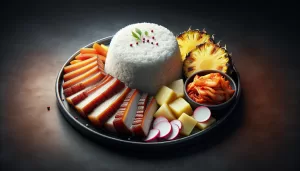
Khao man kai - sliced chicken served with plain rice
Khao na pet -
sliced roast duck with plain rice
Khao na kai - sliced chicken with bamboo
shoots and spring onions in a gravy over plain rice
Khao mu daeng - sliced
cooked pork with egg and gravy over plain rice
Khao mu tot - sliced fried
pork over plain rice (can be ordered with khai, egg, added on top)
Khao rat
na nua - fried vegetables and beef in a gravy over plain rice
Noodle
Dishes
Nam - literally meaning water, is used to indicate a soup dish
Haeng - literally just meaning dry, is used to indicate that a dish is
without broth
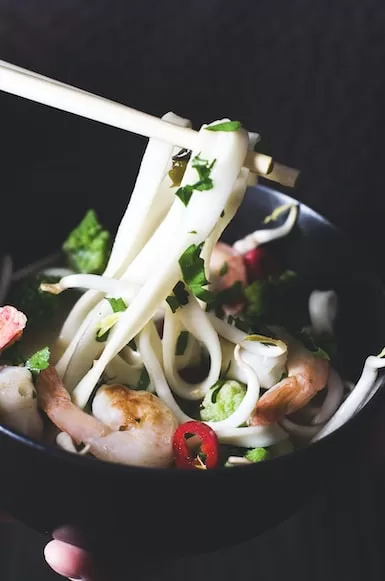
Kuai tiao - rice noodles
Ba mi - wheat and egg noodles -
Ba mee
Kuai tiao lat na - wide white noodles with meat, vegetables and gravy
placed on top
Kuai tiao haeng - white noodles flavored with a small amount
of meat, vegetables (preferably bean sprouts) and spices
Kuai tiao nam -
same as above, but with a broth added
Kuai tiao phat - Thai thin white
noodles fried with bean sprouts and a small quantity of many other ingredients
including meats
Kuai tiao phat si iu sai khai - noodles fried with Chinese
sauce, meat, vegetables and egg
Ba mi nam - boiled wheat and egg noodles
with broth
Ba mi haeng - same as above but without broth
Ba mi na mu -
(nua, kai, kung, pu) fried yellow noodles with pork (beef, chicken, shrimp, crab
meat)
Ba mi na phak - same as above, but with vegetables
Ba mi krob rat
na kung - crisp fried yellow noodles with shrimp
Ba mi krob rat na mu - same
as above but with pork
Ba mi krob rat na kai - same as above, but with
chicken
Kieo nam wanton - (meat ball) soup
Kieo haeng - wanton with bits
of vegetables and spices