The Philippines is located in the southeastern portion of Asia. Her
neighbor on the north is the Republic of China (Taiwan or Formosa),
while on the west is Communist Vietnam. Further west is Thailand.
Immediately to the south of the Philippines is Indonesia and to the
southwest are Malaysia and Singapore.
The Philippines is separated from her nearby Asian neighbors by several
bodies of water. They are the Pacific Ocean on the east, the South China
Sea on the north and west, and the Celebes Sea and the coastal waters of
Borneo on the south.
I. LAND AND ITS PEOPLE
The Philippines is an archipelago of 7,107 islands and islets. The
biggest islands are Luzon, with a land area of 40,530 square miles
(105,000 square kilometers); Mindanao, 36,670 square miles (95,000
square kilometers); Palawan, 5,749.86 square miles (14, 896 square
kilometers); Negros, 5,278.55 square miles (13,675 square kilometers);
and Samar, 5,183.59 square miles (13,429 square kilometers). She has a
rugged land mass and, similarly, she has an irregular coastline, which
is twice as long as that of the continental U.S.A. This irregularity has
resulted in numerous fine harbors and landlocked straights that can
accommodate large ships. They can also be a refuge of ships in distress
during stormy weather.
The land surface is 115,800 square miles (300,000 square kilometers).
Land forms include hills, plains, valleys, and mountains. Her mountain
ranges, which are volcanic in origin, are drained by small river
systems. There are seven major mountain ranges. The largest and longest
is Sierra Madre, which faces the Pacific Ocean on the eastern coast of
Luzon. The highest peak is Mt. Apo, a volcano in Davao del Sur Province.
It has an elevation of 9,691.60 feet (2,954 meters).
Three Major Islands. The three major geographical groups in the country are Luzon, Visayas, and Mindanao. Luzon comprises the northern portion of the archipelago. The Visayan region has about 6,000 islands including Leyte, Cebu, Samar, and Bohol. Mindanao is the second largest land and encompasses about 400 small islands.
These islands are divided into provinces, which are run like states in
the United States. Each province is ruled by a governor, a vice
governor, and members of the provincial board. Each province is composed
of cities, towns, and barrios.
Several “Pinatubos.”There are several volcanos in the Philippines.
These have been one of the natural causes of destruction to life and
property for centuries. At least 10 are considered active. The most
famous are Iraya on Batanes Island; Taal in Batangas; Banahaw in Quezon;
Mayon in Albay; and Hibok-Hibok on the Camiguin Islands; Makaturing in
Lanao; Apo in Davao, and Mt. Pinatubo in Zambales.
Mt. Pinatubo has gained notoriety as being the most destructive volcano
in the world. It lay dormant before it erupted in June 1991. It directly
and indirectly caused damage to public and private property in the
provinces of Zambales, Bataan, and Pampanga, including the Clark Air
Force Base in Angeles City, Pampanga Province. Its ashes spread all over
the world, causing global warming, damage to the ozone layer, and
adverse effects on communications.
After six years of eruption, the lahar deposits along the volcano still
cascade down the slopes after heavy rains. They continue to take lives,
destroy bridges and roads, and defy billion-peso dikes built to contain
lahar flows. These lahar flows are expected to last for five or more
years, according to volcanologists. The Philippines lies within the
Pacific seimic belt, which is why she experiences severer earthquakes.
Christian Groups. The people of the Philippines number about 73,265,584 (July 1995 estimate).
There are several ethnic groups and more than 65 so-called cultural
minorities in the Philippines, which speak their own dialects or
languages. Among these ethnic groups are the Tagalog, the Ilocano, the
Pangasinanian, the Pampangue?o, the Bicolano, the Cebuano, the Ilongo,
and the Waray-Waray. They comprise more than 90 percent of all Filipinos
and are the Christians. About 84 percent of Filipinos are Roman
Catholics.
The Tagalogs live in Manila and in central and southern Luzon. Although
they speak Tagalog, they have intonations of their own, as do the
Batangue?os from Batangas Province. The Tagalogs mostly live in such
provinces as Nueva Ecija (the Ilocanos also live in some towns in the
northern part of the province), Bulacan, Rizal, Batangas, Quezon,
Laguna, and Mindoro (Oriental and Occidental). The Tagalogs dominate the
people in Manila. There are, however, many people in the city who have
come from different parts of the country, including Luzon, to live in
the big city. Many also have come from the Bicol region and the Visayan
islands.
The Ilocanos live in the Ilocos region in northern Luzon, particularly
Ilocos Sur and Ilocos Norte, but many of them have migrated in large
numbers to central Luzon, and, of course, to the United States. Most of
the oldtimers in the United States in the late 1920s and early 1930s
came from the Ilocos region. The Ilongos live in western Negros, in
southern Mindoro, and on the island of Panay. The Cebuanos predominate
in Cebu, western Leyte, Bohol, eastern Negros, and in some coastal areas
of Mindanao.
The Bicolanos are in the southeastern Luzon and nearby islands,
including the provinces of Albay, Camarines Norte, etc. The Pampangue?os
or Kapampangans live in central Luzon, particularly in Pampanga
Province. The Pangasinanians live in the Lingayen Gulf region of Luzon,
including Pangasinan Province; however, many Pangasinanians have
migrated into other towns in central Luzon. The Waray-Warays are in the
provinces of Samar and eastern Leyte.
Other Groups.Chinese and other groups also live in the Philippines.
The Chinese comprise 1.5 percent of the population, and are active in
business.
Cultural Minorities. There are more than 65 cultural minorities, similar
to the Indian tribes in the United States, who live in reservations and
in the mountains.
They include the Muslim groups, which are comprised of the Maranao, the
Samal, the Maguindanao, the Tausug, etc. They live in the Sulu
Archipelago and southern Mindanao.
There are also the so-called upland tribal groups who live in the
mountain regions of the country, such as in the Mountain Province of
Luzon. In northern Luzon, the other ethnic groups include the Bontoc,
the Kalinga, the Ifugao, the Kankanay, the Ibaloi, the Isneg, the
Ilongot, the Tinguian, and the Gadang.
The Mangyan group lives in Mindanao and the Batak and the Tagbanua live
in Palawan. In Mindanao there are groups known as the Tiruray, the
T’Boli, the Bagobo, the Mandaya, the Bukidnon, the Subanun, and the
Manobo. The Negritoes, popularly known as the Agta or the Aeta live in
the mountainous areas of Luzon, Negros, Panay, and Mindanao.
“I love You! Iniibig Kita!” Yes, “I love you” is said in about 87
dialects or languages in the Philippines. These include Tagalog,
Kapampangan, Ilocano, Cebuano, Pangasinanian, Bicolano, Hiligaynon,
Chabacano, and the different dialects spoken by other ethnic groups such
as Muslims and cultural minorities.
The Filipino dialects belong to the so-called Malayo-Polynesian language
family, which is said to be the largest language family throughout the
world. Pilipino (not Filipino), which is based on Tagalog, is the
national language in the Philippines, but both English and Pilipino, are
the official languages in schools, in government, and in private
institutions, especially in urban places. English serves as the official
language used in communications and in business meetings, especially by
Rotarians, Jaycees, and other organizations. That is, English and
Pilipino both serve as the media of communications among the people who
also speak their own dialects.
It is common that when a Filipino in the Philippines and a Filipino in
America write to each other, they communicate in English. But in daily
conversation, English and Pilipino are combined, which is called Taglish
(meaning Tagalog (Pilipino) and English. For instance, one may say,
“Pupunta ako sa Maynila, to enroll at the University of the Philippines,
(I’ll go to Manila to enroll at the....) or “Okeng, okey ka, you’re so
sweet!” (You’re okay and you’re so sweet!”)
So whenever you meet Filipinos in the United States, they may be
speaking their own dialects when not speaking in English. However, these
groups know Pilipino. So if you want to know a Filipino language, it
should be Tagalog or Pilipino so that you’ll have more people whom you
can converse with.
Government.The Philippines has a democratic form of government, like
that of the United States. The government is divided into executive,
legislative, and judicial branches.
Have Pesos and Enjoy!If you have the dollar, you can have it changed to
the Philippine peso. The dollar when this book was about to go to press
was equivalent to forty pesos (P40.00). The Philippine currency consists
of the peso (P) and the centavo. One hundred centavos equal P1. Coin
denominations are 1, 5, 10, 25, and 50 centavos, and P1, P2, and P5.
Bill denominations consist of 5, 10, 20, 50, 100, 500, and 1,000 pesos.
Foreign currency may be exchanged in banks, hotels, and most large
department stores, which have authorized money-changing shops.
Charge It! Charge It! Most large hotels, stores, restaurants, and resort
areas accept major credit cards, including Visa, Mastercard, and
American Express. At hotels and other large stores, traveler’s checks
are accepted, preferably American Express.
How’s the Weather? The weather in the Philippines is tropical, the
country having only two seasons, the dry and rainy seasons. It’s usually
hot from April to July. The dry season is between November and June and
the rainy season is between July and October. Filipinos consider
December, January, and February as the cool months. But they may not be
considered as winter without snow as in the United States; maybe it’s
milder or like spring or fall.
II. FLASHBACK: THE EARLY FILIPINOS
The Philippines, scientists believe, once was a part of Mainland China.
According to the scientists, during the Ice Age, the waters surrounding
the Philippines dropped to about 156 feet below the present levels,
exposing large bodies of land. These became land bridges connecting the
Philippines to the Asian mainland.
The Philippines, Out from the Bottom of the Sea? In February 1976, Dr.
Fritjof Voss, a German scientist who studied the geology of the
Philippines, questioned the validity of this theory of land bridges. He
maintained that the Philippines was never part of mainland Asia. He
claimed that it arose from the bottom of the sea and, as the thin
Pacific crust moved below it, continued to rise. It continues to rise
today. The country lies along great Earth faults that extend to deep
undersea trenches. The resulting violent earthquakes caused what is now
the land masses forming the Philippines to rise to the surface of the
sea.
Dr. Voss also pointed out that when scientific studies were done on the
earth’s crust from 1964 to 1967, it was discovered that the
35-kilometer-thick crust underneath China does not reach the
Philippines. Thus, the latter could not have been a land bridge to the
Asian mainland.
When They Came, How They Came.The traditional teaching of Philippine
history in Filipino schools today has early Philippine habitants coming
in waves.
In 1962, it was concluded that about 250,000 years ago, primitive men
came to the Philippines from the Asian mainland. Then about 25,000 years
ago came the pygmies, the small, black-skinned, squat-nosed,
thick-lipped, and kinky-haired people from the south over the still
remaining land bridges. (They are considered the ancestors of the
Negritoes, who are, in turn, regarded as the aborigines of the
Philippines.)
Around 12,000 to 15,000 years ago, another Negrito (or Aeta) migration
occurred. They reached Luzon from Borneo over land bridges in Palawan
and Mindoro. The submergence of the land bridges when the ice melted
with the passing of time did not prevent other people from inhabiting
the Philippines.
5,000 to 6,000 Years Ago?The first Indonesians arrived by boat from
Southeast Asia some 5,000 to 6,000 years ago. Much later, around 1500
B.C., a second wave of Indonesians arrived. Then came the Malays in two
successive waves, the first between 800 and 500 B.C. and the second,
between 300 and 200 B.C. From Borneo, they traveled by sailboats and
settled in the three major islands of the Philippines: Luzon, Visayas,
and Mindanao. Subsequent peoples who came from the start of Christianity
until the present time include the Indians (Hindus), the Arabs, the
Chinese, other Eastern Asians, the Europeans, and the Americans.
Who Came First?The matter of who the first settlers were has not been
really resolved. This is being disputed by anthropologists, as well as
the theory of Professor H. Otley Beyer that the first inhabitants of the
Philippines came from the Malay Peninsula.
The Malays now constitute the largest portion of the populace and what
Filipinos now have is a Malayan culture. Anthropologist F. Landa Jocano
of the University of the Philippines contends that what fossil evidence
of ancient men show is that they not only migrated to the Philippines,
but also to New Guinea, Borneo, and Australia. He says that there is no
way of determining if they were Negritoes at all. However, what is sure
is that there is evidence the Philippines was inhabited as early as
21,000 or 22,000 years ago. In 1962, a skull cap and a portion of a jaw,
presumed to be those of a human being, were found in a Tabon cave in
Palawan Province.
The discovery proved that man came earlier to the Philippines than to
the Malay Peninsula; therefore, the first inhabitants of the former did
not come from the latter.
Jocano further believes that present Filipinos are products of the long
process of evolutions and movements of people. This not only holds true
for Filipinos, but for the Indonesians and the Malays of Malaysia, as
well. No group among the three is culturally or racially dominant.
Hence, Jocano says that it is not correct to attribute the Filipino
culture as being Malay in orientation.
According to Jocano’s findings, the peoples of the prehistoric islands
of Southeast Asia were of the same population as the combination of
human evolution that occurred in the islands of Southeast Asia about 1.9
million years ago. The proofs of this are fossil materials found in
different parts of the region and the movements of other peoples from
the Asian mainland during historic times.
He states that these ancient men cannot be categorized under any of the
historically identified ethnic groups (Malays, Indonesians, Filipinos)
of today.
Some Filipino ethnic groups were pagans while others were Muslims. The
pagans were converted to Christianity by the Spaniards. The Americans
later arrived and introduced further cultural changes, which made the
Filipinos more and more different from the peoples of other Southeast
Asian countries.
III. PRE-HISPANIC CULTURE
The Filipinos lived in settlements called barangays before the
colonization of the Philippines by the Spaniards. As the unit of
government, a barangay consisted from 30 to 100 families. It was headed
by a datu and was independent from the other groups. (The Tagalog word
barangay came from the Malay word balangay, a boat that transported them to the islands.)
Usually, several barangays settled near each other to help one another
in case of war or any emergency. The position of datu was passed on by
the holder of the position to the eldest son or, if none, the eldest
daughter. However, later, any member of the barangay could be chieftain,
based on his talent and ability. He had the usual responsibilities of
leading and protecting the members of his barangay. In turn, they had to
pay tribute to the datu, help him till the land, and help him fight for
the barangay in case of war.
In the old days, a datu had a council of elders to advise him,
especially whenever he wanted a law to be enacted. The law was written
and announced to the whole barangay by a town crier, called the
umalohokan.
The People’s Commandments.Pre-college Filipino textbooks teach that the
only written laws of pre-colonial Philippines that have survived are the
Maragtas Code and the Code of Kalantiaw, both prepared in Panay. Some
historians believe that the Maragtas Code was written by Datu Sumakwel,
one of the chieftains from Borneo who settled there. As for the Code of
Kalantiaw, it was said to have been promulgated by the third chief of
Panay and possibly a descendant of Datu Sumakwel, Rajah Kalantiaw, in
1433. W. Henry Scott, however, has disputed the authenticity of the Code
of Kalantiaw.
Classes of Society.There were four classes of society. They were the
ruling class (datu), the freemen and notable persons (maharlika), the
commoners (timawa), and the dependents and slaves (alipin). The alipin were of two kinds: the aliping namamahay, who were household servants, and the aliping saguiguilid, who were slave workers.
Clothing and Ornaments.The natives already wore clothes and personal
ornaments. The men wore short-sleeved and collarless jackets, whose
length reached slightly below the waist. The color of the jacket
appeared to indicate the position of the wearer in society, e.g., red
for the chief, and blue or black for those below him, depending on the
societal class. For the lower part, they wore a bahag, a strip of cloth
wrapped around the waist, passing between the thighs. Their thighs and
legs were left exposed.
A piece of cloth wrapped around the head, called a putong, served as a
head gear. The kind of putong one wore was important. For example, a red
putong meant the wearer had killed a man in war while one who had killed
at least seven people signified so by wearing an embroidered putong.
They also wore necklaces, armlets or kalombiga, earrings, rings, and
anklets, usually made of gold and precious stones.
The women’s upper garment was a sleeved jacket, called a baro. Over
their skirts (saya or patadyong) was wrapped a strip of cloth called tapis. They also wore gem-studded bracelets, necklaces, rings, and gold
earrings.
Tattoos were part of the body ornaments of pre-Hispanic Filipinos, men
and women alike. These were also sported as war “medals.” The more
tattoos, the more impressive was a man’s war record.
The Filipinos from the Visayas Islands were the most tattooed, which was
why early Spanish writers referred to them as Pintados or painted
people. The writers referred to their Islands as Islas del Pintados or
Islands of the Painted People.
Rice and More Rice. Agriculture was the early Filipinos’ main means of
livelihood. They also grew an abundance of rice, sugarcane, cotton,
hemp, coconuts, bananas, and many other fruits and vegetables. Land
cultivation was by tilling or by the kaingin system. With the kaingin
system, the land was cleared by burning the shrubs and bushes. After
that, it was planted with rice and other crops, which were watered by
irrigation ditches.
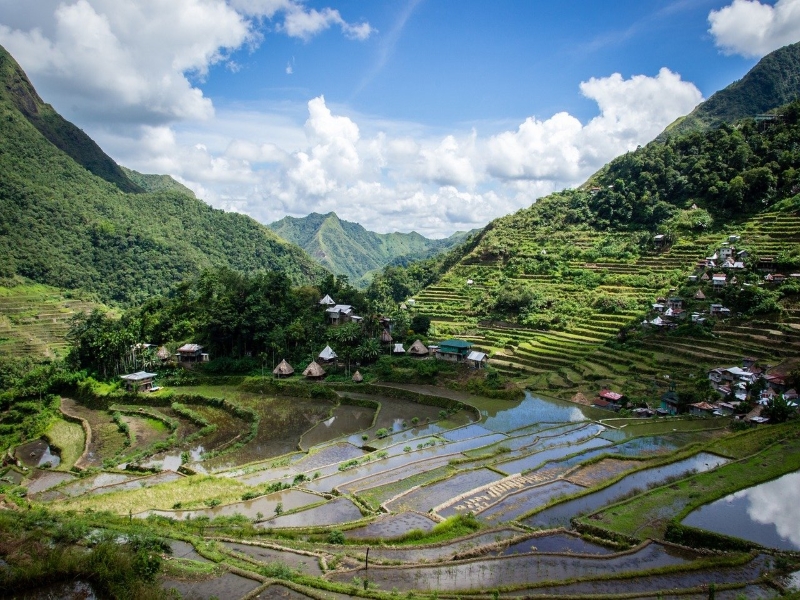
The world-famous Ifugao rice terraces of Mountain Province, which have
stone walls and run for thousands of feet on the mountain sides, are
irrigated by a system of ditches. From afar, the terraces seem to be a
giant stairway leading to the sky. From end to end, the length could be
about 12,000 miles or halfway around the Earth.
There were public and private lands. Those along the mountainsides and
less arable lands were public property. They were open to everyone who
wanted to till them. Private lands were usually exclusively for nobles
and datus.
Other Industries.Other industries were fishing, mining, lumbering,
poultry raising, shipbuilding, and weaving. Fishing was particularly
thriving for the settlements along rivers and seas.
Domestic trade existed among the barangays and the islands. The
Filipinos’ foreign trade was with China, Japan, Siam (now Thailand),
Borneo, Sumatra, Cambodia, and other islands of old Malaysia. The barter
system was used in business transactions because there was no currency.
Their God.Bathala was the supreme god of the pre-Spanish Filipinos.
They attributed to Bathala the creation of the heavens, Earth, and man.
There were lesser gods and goddesses, like a god of death, a god of
agriculture, a goddess of harvest, sea gods, river gods, and the like.
It was also believed that things found in nature were full of spirits
more powerful than man. Spirits of dead relatives were also revered.
Sacrifices were offered to all of them.
The ancient Filipinos believed in the immortality of the soul and in
life after death. Disease or illness was attributed to the whims of the
environmental spirits and the soul-spirits of the dead relatives.
The pre-Spanish Filipinos also revered idols, called anitos in Tagalog
and diwata in Visayan. These seem to be the counterparts of the present
saints, to whom Filipinos offer prayers and food, much like their
ancestors did.
How Islam Conquered Parts of the Philippines.The Islamization of
Southeast Asia was generally accomplished by peaceful means through
Muslim traders, missionaries, and teachers. They went to Java, Sumatra,
Jahore, Malacca, Borneo, and nearby islands to conduct their mission. To
speed up the conversion process, these proselytizers usually married
into the families of the rich and ruling class.
By the 13th century, most of the lands in Southeast Asia were Islamized.
From there, Islam filtered to Mindanao and Sulu, the southern part of
the Philippines, in the 14th century.
In 1380, an Arab teacher, Mukdum, arrived in Sulu from the Malay
peninsula to preach Islam. He built the first mosque in Simunul, Sulu.
Around 1390, he was followed by Raja Baginda, a minor ruler of
Menangkabaw, Sumatra. About 1450, Abu Bakr, a Muslim scholar, came to
Sulu and married Paramisuli, the daughter of Raja Baginda. After Baginda
died, Abu Bakr established a sultanate form of government with himself
as sultan. Islam then spread rapidly to all parts of Sulu.
Serif Kabungsuan was responsible for the spread of Islam in Mindanao. He
led a force of Muslim Samals from Jahore that conquered the natives of
what is now Cotabato and converted them to Islam. He also married into
an influential family and founded the first sultanate of Mindanao, with
himself as head.
On the other hand, Muslim Malay traders from Borneo spread Islam to the
natives in Manila and in the provinces of Batangas, Mindoro, and
Pampanga. When the Spaniards arrived in the Philippines during the first
half of the 16th century, many parts of Luzon, including the large
native kingdoms of Manila and Tondo, had already been Islamized.
However, the further spread and influence of Islam were cut short by the
conquest and Spanish colonization of the Philippines starting in 1665.
Chinese and Indians.Chinese influences on Filipino life were mainly
economic. However, at the same time, cultural influences were
inevitable. Many words in the Philippine language have Chinese origins.
The Chinese also taught the ancient Filipinos the use of gongs,
umbrellas, lead, and porcelain, as well as the manufacture of gun
powder, and metallurgy and mining methods. Filipinos also adopted
customs from the Chinese.
Many words in the Philippine language also appear to have Sanskrit
origins. In addition, ancient religious beliefs of the Filipinos show
Indian influence. It is said that some elements of the Indian culture
reached the Philippines through the Hinduized Malays who settled in the
country permanently.
IV. UNDER FOREIGN INVADERS
The Philippines was colonized by the Spaniards for about 333 years and
by the Americans for 48 years. Later, World War II broke out and the
Japanese occupied the Philippines for three years. (See chapter 2: The
Spanish Colonization of the Philippines (1565-1898); chapter 4: The
Philippine-American War (1899-1902); and chapter 5: The Japanese
Occupation of the Philippines, (1942-1945).)
V. THE HUK REBELLION
After World War II, the bad relationship between landlords and farmers,
who were seeking better conditions, became worse. The tenancy problem
plagued the country, particularly in the provinces of Pampanga, Bulacan,
Nueva Ecija, and Tarlac in central Luzon.
There was too much tension when the landlords who evacuated to urban
areas during the war came to the rural areas to ask for back “rent” for
their lands from the farmers. With the help of their own armed bands,
they tried to force the peasants to give to them what they owed them.
At the same time, the Huks, or Hukbalahaps who fought against the
Japanese as U.S.-supported Filipino guerillas did, were reluctant to
give up their arms.
As a result, General Douglas MacArthur put to jail Luis Taruc and Casto
Alejandro, the leading Huk leaders. Furthermore, the U.S. forces were
ordered to disarmed the Huks. Instead, the Huks fled to the mountains.
Still armed, they supported the Pambansang Kaisahan ng mga
Magbubukid-PKM (National Peasant Union) in its fight against the
landowners.
By that time, the peasants’ movement represented about 500,000 members.
The PKM, as part of the left-wing Democratic Alliance, which also
included other groups, had supported Sergio Osme?a as the Nacionalista
Party’s presidential candidate against Manuel Roxas during the 1946
election campaign. Osme?a was the president of the Philippine
Commonwealth, who replaced President Manuel Quezon after he died in the
U.S. in 1944.
Osme?a got the support of the labor movement. He promised the farmers
that a new law giving 60 percent of the harvest, instead of the then 50
percent or less, would be passed. At that time, Taruc, who was released
from jail, and five other candidates of the Democratic Alliance won
congressional seats during the 1946 elections which elected Roxas to the
presidency.
However, Taruc and the other Democratic Alliance winners were not
allowed to be installed into their positions. They were accused of
having used terrorist acts during the campaign. Violence by landlords
with the help of the police worsened against peasant activities. In
August 1946, Juan Feleo, a PKM leader was killed, resulting in the
rebellion of the Huks in central Luzon. The People’s Liberation Army
(Hukbong Mapagpalaya ng Bayan) became the new name of the People’s
Anti-Japanese Army.
VI. FROM PHILIPPINE INDEPENDENCE TO RAMOS REGIME
The United States, as provided in the Jones-McDuffie Law of 1934,
granted independence to the Philippines on July 4, 1946.
The Roxas Administration (1946-1948). Inaugurated as first president of
the new republic was Manuel A. Roxas, who defeated then-President Sergio
Osme?a, Sr., in the April 1946 national election. (Osme?a was elected
vice president in 1935 and succeeded Quezon to the presidency after the
latter died while in exile in the United States.)
President Roxas, a native of Capiz (now Roxas City) had to deal with the
rehabilitation of the Philippines, tremendously ravaged by World War II.
Various agreements with conditions, in favor of the United States, were
discussed and approved by the authorities. One such condition was that
American investors be given “parity” rights. That is, the U.S. investors
had the right to be treated as equals of Philippine nationals, not as
investors from any other foreign country.
At the same time, there were absolute quotas of Philippine exports to
the United States. On the contrary, there were no quotas for American
exports to the Philippines. Moreover, the U.S. military obtained
military bases in the Philippines without any rent for 99 years. The
duration was later reduced. The lease was to end in 1991.
In February 1948, President Roxas pardoned those who had cooperated with
the Japanese during the war. Those who had served the Japanese were
called “collaborators.” Roxas himself had played a part in the
Japanese-sponsored wartime “puppet government.”
It was during the Roxas administration that the Philippine Constabulary
and landlord private armies had their days fighting the Huks and their
farmer supporters over tenancy problems. The Huks had earlier fought the
Japanese along with U.S-supported Filipino guerillas. But later, they
supported the peasants in their fight with the landlords to improve the
economic conditions of the land tenants.
At first, President Roxas held negotiations with the Huks. As a matter
of fact, his administration created an Agrarian Commission that passed a
law giving 70 percent of the harvest to the tenants. However, there were
difficulties in implementing the law.
On the other hand, the Huks demanded that the winning congressmen of the
Democratic Alliance be reinstated, among whom was Luis Taruc. They
likewise demanded that the military police be disbanded and a general
amnesty be given to those involved in the movement. Instead, President
Roxas in March 1948 declared the People’s Liberation Army as a
subversive organization.
Quirino Comes to Power (1948-1953).In April 1948, Roxas died of a heart
attack. He was succeeded by Elpidio Quirino, his vice president.
Quirino, a native of Vigan, Ilocos Sur won as president in the 1949
election against Jose P. Laurel, who was president in the Second Puppet
Republic during the Japanese Occupation of the Philippines.
Quirino’s main goals in his administration were to obtain peace and
order and minimize graft and corruption in the government. He believed
that mass corruption existed during the Roxas administration. But
Quirino also was severely criticized by the press and the public for
alleged corruption.
It was during his administration that the Huks increased to a greater
number. In the 1949-51 period, there were between 11,000 and 15,000
armed Huks. Although they were mostly in central Luzon, there were
regional committees of the People’s Liberation Army in provinces now
known as Southern Tagalog region, in northern Luzon, Visayan Islands,
and Mindanao. Quirino appointed Ramon Magsaysay, a former guerrilla and
a congressman from Zambales Province, as secretary of defense to fight
the Huks. With the efforts of Magsaysay, the backbone of the Huk
movement in central Luzon was broken.
The Magsaysay Era (1953-1957). In 1953, because of his popularity and
his success in fighting the Huks, the Nacionalista Party lured Magsaysay
to be its presidential candidate. He was then called as “Man of the
People.” They also said, “Magsaysay Is My Guy.”
Born in Iba, Zambales, Magsaysay defeated Quirino of the Liberal Party
in the November 1953 election. As a man of the people, he opened the
Malacaang Palace, the White House of the Philippines, to the people. He
also established special courts for landlord-tenant disputes and built
roads, bridges, irrigation canals, and “liberty wells” in the rural
areas. The Huk movement further weakened with the surrender of Luis
Taruc in May 1954.
In 1955, Magsaysay worked for the redistribution of land. In that same
year, Congress passed the so-called Land Reform Act. The law created the
Land Tenure Administration that had the power to acquire private lands
through either purchase or expropriation. Such lands would be sold by
the government to farmers at reasonable prices.
However, the law was hampered by a lack of funds. Hence, Magsaysay, was
not able to push through in Congress his full program for land reform.
He died in March 1957 in a plane crash at Mt. Pinatubo.
The Garcia Regime (1957-1961).Carlos P. Garcia, Magsaysay’s vice
president, succeeded him to the presidency. Garcia, a native of Talibon,
Bohol Province, was himself elected president in the 1957 election.
Diosdado Macapagal, of the opposing Liberal Party, won the vice
presidency.
President Garcia immediately imposed import controls on manufactured
goods from abroad. His objective was to jump-start the Philippine
economy. His administration was known for its program of austerity and
its “Filipino First” policy, with a view to creating economic
independence for the Philippines. This led to a kind of
industrialization. However, as in the time of President Quirino,
Garcia’s government was plagued with graft and corruption.
The Macapagal Administration (1961-1965). With graft and corruption as
the election issue for the 1961 election, Garcia was defeated by the
Liberal Party’s Diosdado Macapagal. Calling himself the “Poor Boy” from
Lubao, Pampanga, Macapagal lifted the import controls imposed by Garcia.
In 1963, Macapagal signed the Agrarian Land Reform Code into law. The
code abolished tenancy by the institution of an agricultural leasehold
system, which was intended to lead toward the eventual goal of ownership
of the land by the farmers. However, when Macapagal’s term ended in
1966, the extent of the land area affected was not significant. Only
about 29,150 hectares of the 405,000 hectares of rice and corn, were
cultivated by tenants.
Macapagal was also known for his changing the Independence Day of the
Philippines from July 4, 1946 (given by the United States) to June 12,
1898. It was on the latter date that President Emilio Aguinaldo had
declared the Philippine independence in his hometown in Cavite from
Spain.
Besides launching his version of Agrarian Reform, Macapagal promoted the
stability of the peso and initiated a socio-economic program for the
betterment of the poor.
The Era of Marcos: A President Who Became a Dictator (1965-1986). In the
1965 presidential election, Macapagal was defeated by Ferdinand E.
Marcos, a former Liberal, who became the Nacionalista Party’s
presidential candidate. In 1969, Marcos, a native son of Sarrat, Ilocos
Norte, won his reelection.
However, during the Marcos regime, corruption in the government reached
unparalleled proportions. Thus, opposition to Marcos’s administration
grew stronger and stronger. On September 21, 1972, President Marcos
imposed martial law. He abolished Congress, clamped opposition print and
broadcast media, and jailed thousands of his critics. He became an
absolute dictator. His presidential proclamations became the laws of the
land.
In 1973, his second and final term as president should have ended.
However, with martial law, Marcos continued to rule as the absolute
dictator in the Philippines. Plebiscites were held during the years
1973, 1975, and 1978. However, the will of the Filipino people didn’t
prevail. All the plebiscites of disputable legitimacy gave approval to
the extension of martial law.
In 1978, the Philippines held elections for the legislature (the
National Assembly had replaced the former Congress). Marcos’ party, the
Kilusang Bagong Lipunan (KBL), or New Society Movement obtained three
quarters of the seats in the national assembly. In 1981, Marcos formally
ended martial law. However, as president, he had emergency powers. In
June 1981, in an election during which many people didn’t vote, Marcos
won another six-year term as president.
During the martial law era, both the administrations of U.S. Presidents
Ronald Reagan and Jimmy Carter continued to give military and other
economic aid to the Marcos administration.
In August 1983, Senator Benigno Aquino, Jr., a staunch Marcos critic,
went home to the Philippines from his exile in the United States. He was
murdered at the Manila International Airport upon his arrival.
In February 1985, General Fabian Ver and 24 other soldiers were tried by
a special court composed of what the opposition groups called “Marcos
loyalists.” Ver and his soldiers were acquitted.
A so-called “snap” presidential election, proposed by President Marcos
himself, was held in February 1986. Corazon Aquino, wife of the late
Senator Aquino who was murdered, became Marcos’ rival candidate. Aquino,
with the backing of the people, won a clear majority of the votes.
However, Marcos had the National Assembly declare himself winner in the
election.
A section of the military, led by Juan Ponce Enrile, Marcos’ secretary
of defense, and Fidel Ramos, chief of staff of the armed forces of the
Philippines, rebelled against the dictator. Due to the mass
demonstrations in Manila, called “people power,” Marcos was forced to
escape aboard a U.S. Air Force plane to the United States. That ended
the Marcos regime and started the rule of President Aquino. Marcos died
in exile in the United States.
The Aquino Regime (1986-1992). Upon taking over the presidency,
President Aquino, freed all political prisoners jailed by President
Marcos. In the same year, all presidential decrees by Marcos were
revoked, and the constitution, the fundamental law of the land, was
adopted by a nationwide plebiscite in 1987.
During her administration, Aquino attempted to alleviate the economic
conditions of the people. However, she was not successful. In fact, some
criticized the weakness of her administration in dealing with economic
problems. Furthermore, during her term, some elements of the armed
forces, along with Marcos loyalists, revolted seven times against the
Aquino government. The coup attempts were thwarted by loyal sectors of
the military, led by Fidel V. Ramos, chief of staff of the armed forces
and secretary of defense.
It was during the Aquino administration that the issue of extending the
expiring leases of U.S. military bases in the Philippines came about. In
September 1991, as Aquino objected to it, the Senate disapproved the
extension of the leases of the bases. (Earlier, in June 1991, the nearby
Mount Pinatubo damaged the Clark Air Force Base in Pampanga rendering it
unusable.)
Former Executive Secretary Joker Arroyo said of Aquino, “Cory Aquino’s
greatest legacy is the fact that we are all here today, talking freely.”
In the next presidential election, President Aquino didn’t seek
reelection. She chose Fidel V. Ramos, as her candidate for president.
The Ramos Administration (1992-1998).Fidel V. Ramos won in the 1992
presidential election against six other candidates. In the last five
years of his administration, he has changed the Philippines from being
“the Sick Man of Asia” into “The Next Tiger of Asia.”
In September 1992, he lifted the ban on the Communist Party. Likewise,
he eliminated foreign-currency restrictions to attract foreign
investment to the Philippines. Ramos, besides courting foreign
investment, has liberalized the Philippine economy to move toward
industrialization.
He negotiated with the Moro National Liberation Front (MNLF), headed by
Nur Misuari, to bring peace in Mindanao, the southern part of the
Philippines.
A peace agreement between the Philippine government and the Muslim group
was signed on September 2, 1996, that ended the 24-year-old war in
Mindanao. The agreement was signed by the government chief negotiator
Manuel Yan, Nur Misuari, Indonesian Foreign Minister Ali Alatas, and
Secretary General Hamid Algabid of the Organization of Islamic
Conference (OIC).
Later, Misuari ran for and won the governorship of the Autonomous Region
for Muslim Mindanao (ARM) in the September 9, 1996, elections.
Due to his economic programs and accomplishments, Newsweek Magazine,
cited the Philippines as the “The Next Tiger of Asia.” The Ramos term
ends this year, 1998. (See Ramos’ economic program as envisioned in
Philippines 2000.)
VII. THE MODERN PHILIPPINES
Today, the Philippines, an independent nation of about 70 million
people, is becoming one of the most progressive countries in Asia. The
Philippines has rebounded from the economic debacle that former dictator
Ferdinand Marcos had put her into. Investors from the United States,
Japan, Malaysia, and other nations in Asia are bringing in millions of
dollars as investment in factories, recreation establishments, and other
businesses.
The “States” of the Philippines.A “state” in the Philippines is called
a province. The Philippines has 72 provinces and 61 chartered cities.
Manila and Its Satellites. Metro Manila is the political, economic,
social, educational, cultural and recreational hub of the Philippines.
It comprises the city of Manila, Quezon City, Makati, and other suburban
cities.
Malls, boutiques, flea markets, and other shops abound in Manila and its
environs. You’ll be amazed at beautiful attractions in Manila itself,
like the Intramuros, the old walled city, and Chinatown. Here you’ll see
a number of McDonald’s, Burger King, Wendy’s, and Kentucky Fried
Chicken. When you’re inside the malls and you don’t concentrate on the
crowd, you’d think that you were somewhere in America.
Manila: Where Admiral Dewey Met His Destiny. A long time ago, Manila was
a small tribal settlement on the banks of the Pasig River near Manila
Bay. On May 1, 1898, Dewey’s naval fleet destroyed the Spanish Fleet on
Manila Bay.
It was on May 24, 1570, when Spanish Marshall Martin de Goiti’s
expedition reached Soliman’s settlement. On June 24 of the following
year, Adelantado Miguel Lopez de Legazpi founded the city of Manila,
which he called the “distinguished and ever loyal city” of Manila. He
proclaimed it as the capital of the islands.
During the old times, in the suburbs or arabales, such as Quiapo, Tondo,
Santa Cruz, and Malate, the Filipinos, then known as indios, lived and
worked together with the so-called mestizos (of mixed Filipino and
foreign descent). The Chinese merchants called Sangleys, lived in a
district called parian, which now comprises an area known as Binondo.
Intramuros, which means within the walls, was the original Walled City.
It was the site of the native settlement called Maynilad, ruled over by
Rajah Soliman. It was at that time the center for the trade of goods
from Asia. It was in this walled city where the Spaniards sought refuge
when the American troops came during the Spanish-American war. It was also here that the so-called “mock battle” took place between the Spanish and American forces, where Filipino troops were excluded from participating.
Intramuros is now a tourist attraction. Local and foreign tourists have
the option of enjoying walking tours from 30-minute to 2 hours. Among
the attractions in Intramuros are Fort Santiago, Rizal Shrine, Casa
Manila Museum, San Agustin Church, Intramuros Walls Museum, and San
Agustin Museum.
Moreover, performances such as Serenata sa Fort Santiago and the Marian
Procession are held in Intramuros. The Serenata sa Fort Santiago is performed as an open-air band concert in the tradition of the outdoor concerts in the paseo of the Old Luneta. It is held every Sunday from April to mid-May. On the other hand, the Marian Procession is held annually in December. This procession is in commemoration of the 400-year-old celebration of the Feast of the Immaculate Concepcion. The activity is a grand display of various images of the Virgin Mary.
There are also other activities in Intramuros.
Where to Go. What to See.There are a lot of tourist attractions in the
Philippines. Here are some suggested destinations by the Philippine
Department of Tourism:
Boracay. Made up of three little communities, Boracay, a “paradise
island,” is at the northwestern tip of Panay Island in the West Visayas
region. The communities are Yapak in the north, Balabag in the middle,
and Manocmanoc in the south. About a dozen beaches dot the island.
Bamboo outriggers ferry visitors. There are also horses and bicycles for
riding.
Night life is fun.Avail yourself of bars and discos up to the wee hours
of the night. Or take a stroll in the beach by the moonlight. At Yapak,
with an experienced guide, you may wish to explore the bat caves.
Windsurfing and parasailing gear are readily available in the
2,000-hectare area of Boracay. You can enjoy sailing with the help of
local sailors to make your stay enjoyable and memorable.
Boracay is an international place. When you’re there, you’ll hear
different languages: English, Pilipino, German, etc. Foreign cuisine
such as French, Belgian, German, Thai, Spanish, and Australian are
available, together with native cuisine. What a wonderful life!
If you’re going there from Manila, you can go to Boracay by taking a
50-minute Philippine Airlines flight to Kalibo, Aklan Province. From
there, you’ll take another 2-hour inland ride via bus or jeepney to
Caticlan. (Or you may take a flight straight to Caticlan). At Caticlan,
you may be asked to complete forms with regard to travel information.
From there, you you’ll reach Boracay via outrigger boats.
Banaue/Mt. Data, Saga-da. The natives of Banaue are called Ifugaos or
rice eaters. The attractions there are the Banaue Rice Terraces, which
were carved out of the mountain about 2,000 years ago. These rice
terraces are called the “magnificent stairway to the god’s domain.” They
rise up to 1,500 meters high and extend to over 20,000 kilometers. The
ideal visiting time to see them is between March and June, when the
terraces are green with shoots or golden with ripe rice seeds.
VIII. THE PHILIPPINES 2000
The Philippines 2000, is a strategy and a movement; it is the Filipino
people’s vision of development by the year 2000. As envisioned, the
Philippines by the year 2000 will have the decent minimum of food,
clothing, shelter, and dignity. The major goal of Philippines 2000 is to
make the Philippines the next investment, trade, and tourism center in
Asia and the Pacific.
The Birth of Philippines 2000.The Philippines 2000, as a movement,
started to gather momentum in the form of multi-sectorial consultations.
These consultations were geared to pave the way for the Philippines’
entry into the 21st century. Today, involved in these endeavors are
people from government, business and private sectors, labor, and other
sectors forming a “strategic alliance” under the leadership of President
Ramos.
IX. RESULTS OF THE PANIC IN ASIA
In July 1997, as a result of the Hongkong stock market crash, all the
currencies in Southeast Asia, including the Philippine peso, suffered
steep falls in value against the U.S. dollar. The collapse of the stock
market there was triggered by the jacking up of interest rates initiated
by Hong Kong to protect its currency against any speculative attack.
You can also donate to help us to continue to provide our services Thanks for your support.
Clicking on these ads helps provide funds and scholarships to poor students at Pongyang Elementary School in Chiang Mai, Thailand. The children there thank you for your support. And so does AsiaRecipe.com...
We know banners can be annoying at times, but we hope you will appreciate the good your support does. Thanks for your patience.