Quick Facts
AREA: 99,392 sq km (38,375 sq miles, excluding
demilitarised zone).
POPULATION: 45,545,282 (official estimate 1996).
POPULATION DENSITY: 458.8 per sq km.
CAPITAL: Seoul. Population: 10,229,262 (1995).
LANGUAGE: Korean.
RELIGION: Mahayana Buddhism with a large Christian
minority. Also Confucianism and Chundo Kyo.
TIME: GMT + 9.
ELECTRICITY: 110/220 volts AC, 60Hz. Policy is to
phase out the 110-volt supply.
COMMUNICATIONS: Telephone: IDD is available to Seoul and other major
cities. Country code: 82. Outgoing international code: 001. Fax:
Available at major hotels and business centres. Telegram: There is a
service at all main hotels. Korea International Telecommunications Services at
1, Choongmo-ro, Chung-ku, Seoul provide a 24-hour public service. Post:
Airmail to Western Europe takes up to ten days. Post offices open 0900-1700
Monday to Friday; 0900-1300 Saturday. Press: English-language national
dailies are The Korea Herald and The Korea Times.
BBC World Service and Voice of America frequencies: From time to time
these change. See the section How to Use this Book for more information.
BBC:
MHz 17.83 15.28 11.96 9.740
Voice of America:
MHz 17.74 15.31 11.72 6.045
The Korean Peninsula extends for
about 1,000 kilometers southward from the northeast part of the Asian continent
and consists of the Korean Peninsula and over 3,400 islands.
The peninsula and all of its associated islands lie between 33 ?? and 43 ??
parallels and 124 ?& and 132 ?& meridians. The northernmost point is Yupojin in Onsong-gun,
North Hamgyong Province, and the southernmost point is Marado Island,
Cheju Province. The westernmost point is Maando Island in Yongchon-gun, North
Pyongan Province, and the easternmost is Tokdo Islets in Ullunggun, North Kyongsang
Province. The standard meridian of the peninsula is 135 ?& , so Seoul
local time is nine hours ahead of Greenwich Mean Time.
The Amnok
(Yalu) River and the Tuman (Tumen) River border both China and Russia to the
north and Japan is just across the East Sea. Since 1945, as a byproduct of the
Cold War, the peninsula has been divided at the 38th parallel into the Republic
of Korea, or South Korea, and the Democratic People's Republic of Korea, more
commonly known as North Korea.
Lacking formidable land or sea
barriers along its borders and occupying a central position among East Asian
nations, the Korean Peninsula has served as a cultural bridge between the
mainland and the Japanese archipelago. Korea contributed greatly to the
development of Japan by transmitting both Indian Buddhist and Chinese Confucian
culture, art, and religion.
The total area of the peninsula is
221,607 square kilometers, similar in size to that of the U.K, New Zealand, or
Romania. South Korea possesses 99,237 square kilometers or 45% of the total
landmass, while North Korea 122,370 square kilometers, the remaining 55%. Korea
has a varied terrain, though about 70 percent of the territory is mountainous.
The spectacular Mountains Taebaek run the full length of the east coast, where
the lashing tides of the East sea, have carved out sheer cliffs and rocky
islets. The western and southern slopes are very gentle, forming plains and many
offshore islands honeycombed with inlets.
The peninsula has many scenic
mountains and rivers, so Koreans often call it the "land decorated with golden
embroidery." The highest peak is Mt. Paektusan, or the Ever White Mountain,
which stands 2,744 meters high on the northern borderline facing Manchuria.
South Korea's highest peak is Mount Halla (1950 meters) in Cheju Province.
Most of the larger rivers are located in the west and have their
tributaries on the north and east sides, and flow into the Yellow Sea and the
South Sea. In South Korea, the Naktong River and the Han River are the two major
rivers responsible for irrigation and industrial water supply. The Han River
flows through Seoul, the capital of the Republic and serves as a lifeline for
the large population in the central region, including Seoul's 11 million
residents. The river also played a significant part in the development of
Korea's ancient civilization.
Surrounding the peninsula on three
sides, the sea has played a remarkable role in Korean life since ancient times,
contributing to the early development of shipbuilding and navigation skills. The
coastline is dotted with bays and it has some of the highest tides in the world.
The eastern coastline has many sandy beaches, while the western side consists
mainly of mud flats and rocky shores. Off the southern coast, more than 3,000
islands of various sizes are scattered and provide beautiful scenery
unparalleled in the world.
.
Archeologists believe that people have
been living on the Korean peninsula for about half a million years. Stone
chopping tools and hand axes have been found in archeological digs in central
Korea. Pieces of old pottery decorated with a comb pattern have been found at
riverside and coastal sites around the country. Farming, including the planting
of rice in the warmer southern regions, started in the Bronze Age, around 3,500
years ago. Archeologists have found carbonized rice grains and farming tools at
many archaeological digs from this time.
Korea's geography was a
major factor in shaping its history; geography also influenced the manner in
which the inhabitants of the peninsula emerged as a people sharing the common
feeling of being Koreans.
The Korean Peninsula protrudes southward
from the northeastern corner of the Asian continent and is surrounded on three
sides by large expanses of water. Although Japan is not far from Korea, in
ancient times the peninsula was affected far more by the civilizations on the
Asian continent than by those in Japan. The Korean people trace their origins to
the founding of the state of Choson, literally meaning the "Land of the Morning
Calm." It dated to 2333 B.C. when Tan-gun, a legendary figure born of the son of
Heaven and a woman from a bear-totem tribe, established Choson.
Ancient Korea was characterized by clan communities which combined
to form small town-states. They rose and fell so that by the first century B.C.
three kingdoms, Koguryo (37 B.C.-A.D. 668), Paekche (18 B.C.-A.D. 660) and
Shilla (57 B.C.-A.D. 935), had emerged on the Korean Peninsula and part of what
is now known as Manchuria.
Ever since Shilla unified the peninsula
in 676, Korea has been ruled by a single government and has maintained its
political independence and cultural and ethnic identity in spite of frequent
foreign invasions. Both the Koryo (918-1392) and the Choson (1392-1910)
Dynasties consolidated their dynastic power and flourished culturally, while
repelling intruders like the Khitans, Mongols, Manchus and Japanese. In the late
19th century, Korea became the focus of intense competition among imperialist
nations, China, Russia and Japan. In 1910, Japan annexed Korea and instituted
colonial rule. National liberation occurred in 1945 but was soon followed by
territorial division. The Republic of Korea in the south has a democratic
government, while the Democratic People's Republic of Korea in the north is
ruled by a Communist regime.
GDP: US$338 billion
GDP per head: US$7,673
Annual growth: -2%
Inflation: 4.5%
Major industries: Machinery, transport, agriculture, textiles
Major trading partners: USA, Japan, Germany
Culture
Korean culture has blossomed during her long history. Though affected by
other Asian cultures, its roots lie deep within the creative Korean psyche, and
it has tended to spread rather than be encroached upon. Japan especially has
adopted many Korean ideas and customs. The delicate styling and fine
craftsmanship of celadon pottery illustrates the refinement of the culture well,
even from as far back as the Three Kingdoms period. Korea has also spawned some
great inventions: its first printing systems predate Gutenberg's, the famous
'Turtle Ship' was the first ever iron-clad battleship, and the Korean alphabet,
devised by a group of scholars in the 15 century, was so effective that it
remains largely unchanged today. The reasons behind Korea's rapid economic
development can be found in this innate creativity.
Cultural
Attractions
Buddhism has played a powerful role in Korean art. A
large number of excellent examples of Korean artwork and architecture can be
found in Buddhist temples and paintings. During the Choson Dynasty, Confucianism
became a leading inspiration for the noblemen to whom the arts of calligraphy
and painting were essential. They have left a legacy of fine brushwork from
which contemporary artists have benefited from.
Traditional
Art
Korea has a long and distinguished cultural history. The current trend in
Korean art is the harmonious combination of traditional and modern styles,
revealing the historical roots and influences of Korean art.
Painting
Tomb
murals from the Three Kingdoms Period are the earliest examples of Korean
painting. Mythological beasts such as dragons and flying horses show an
imaginative and creative spirit. Throughout the Unified Shilla and Koryo
Periods, Buddhism prevailed in every field of life, thus leaving a rich
collection of icon paintings. In the late Koryo Dynasty, ink and brush paintings
of the four "noble plants", (cherry blossom, orchid, chrysanthemum, and bamboo),
which symbolized traditional virtues, became popular. Artists of the Choson
Dynasty produced innovative masterpieces embodying the Korean spirits and
perspectives. There are humorous animal pictures, scroll paintings of dreamlike,
mist-clad mountains, and insightful sketches of everyday life done in brush and
ink. Paintings with folk custom and nature themes flourished in the latter half
of the 18th century. Shin Yun-bok was a celebrated master of this genre.
Calligraphy
Calligraphy, the art of brush writing, is a
traditional art form in Korea, which has exerted a strong influence on social
and cultural life and is still highly respected today.
Architecture
Four
factors have shaped traditional Korean architecture: religions, the availability
of materials, the natural landscape, and an aesthetic preference for simplicity.
Gently sloping rooflines and sturdy, undecorated pillars characterize its
simplicity, harmony, and practical utility. Korea has many original wooden and
stone structures, some dating back over a thousand years. There are also many
skillful reproductions. Traditional architectural designs are also incorporated
in many modern buildings throughout the country.
Pottery
One
of the most significant achievements in Korean art, the perfection of celadon,
was accomplished during the Koryo Dynasty. Korean artisans developed a superbly
controlled glaze that was both beautiful and unique because it fully utilized
the properties of Korea's rich clay. The highest praise is given to the color of
the glaze - a delicate kingfisher green celadon inlaid with a pictorial
underglaze which is called sanggamch'ongja and occupies a central position among
Koryo celadons. The motifs and decorations found on the celadon are additional
reasons for its great popularity among art lovers.
Modern Art
With its characteristic blend of the traditional and modern
arts and the balance of influences from the east and the west, Korean
contemporary art has surged in popularity. Most artists try to be accessible to
their audience, and there are many exhibitions and galleries in any major city,
the largest collections of which are in Anguk-dong and Taehangno areas in
Seoul.
Museums
Visiting the museums of a country is a valuable opportunity to see its
historic treasures and cultural legacies. As in other countries with long
histories, many national, municipal and university museums, as well as a number
of private institutions, preserve Korea's colorful past.
3.
Traditional Performance
Koreans have always had a deep love for
music and dance. Traditional Korean dance and musical performances can be a
memorable part of visiting Korea. These performances can be seen regularly each
Saturday at the Korean Traditional Performing Arts. Some examples of things you
might see are:
Court music : Traditional Korean music can be classified as
court or folk music. Court music is slow, solemn and complex. It is performed
regularly at the National Theater.
P'ansori: This narrative folk song
tells a long, dramatic story.
Folk songs: Folk songs express the emotions
of the working class people.
Samulnori (farmers' dance): Four music
instruments are used in Samulnori: Buk (drum), Ching (gong), Chang-gu (hourglass
drum) and Kkoenggwari (a type of a gong).
Sandaenori (mask dance): Korean
mask dances are silent folk dramas that satirized the high society prevalent
when they were developed, over 200 years ago. They contain many Buddhist and
Shamanism elements.
Madangnori: These performances are similar to the
Western-style musical.
Traditional dance: Traditional Korean dance is
divided into three main types: court, folk and religious. Among all Korean
dances, the best known are the fan dance and the drum dance.
*[Sujech'on,] the most famous composition
of court music, performed on wind instruments Sujech'on is a type of chong'ak,
literally "proper or correct music", which is comprised of both instrumental and
vocal pieces which were generally cultivated by the upper class literati of the
Choson society.
* [T'aep'yongmu,] The Court Dance. One of the many court dances, Taep'yongmu originates with Han Son-jun
(1874-1941), who founded the Choson Dance Institute in 1933. The lone female
dancer is dressed in the rhythms of Shamanistic music. T'aep'yongmu has been
designated an Intangible Cultural Asset in order to assure its
preservation.
* [Kayagum,] a twelve-stringed zither.The Kayagum is
similar to the Chinese cheng and the Japanese koto in structure but is played
differently and has a different timber. The Kayagum dates back to the sixth
century during the rule of King Kasil of the Kaya Kingdom. The thumb, index
finger and middle finger of the right hand pluck the strings, while the index
and middle fingers of the left hand press on the strings of the left side of the
movable bridges.
* [Geomungo]It has 6 lines and 16 flats called
'Goae'. In view of the mechanism that allows it to produce sound, it is similar
to guitar, in that the pitch is decided by the flat location of a finger. The
left fingers are placed on the Goae to control pitch and the right hand grasps a
stick called 'Sul-Dae' and plucks the strings. The sound of the Geo-Mun-Go is
less clear and sharp than most string instruments, but nevertheless it can fully
convey the feeling of people.
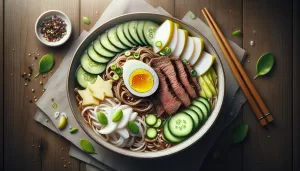
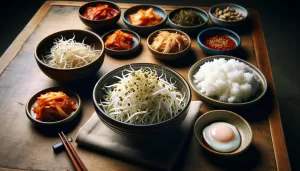
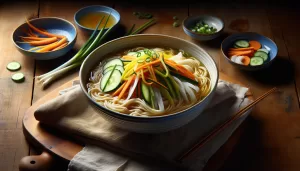
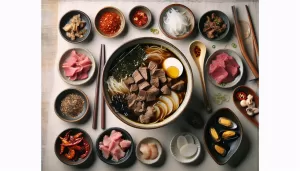
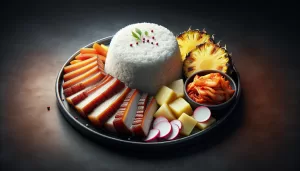
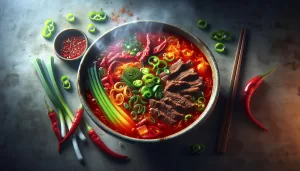
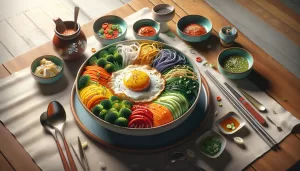
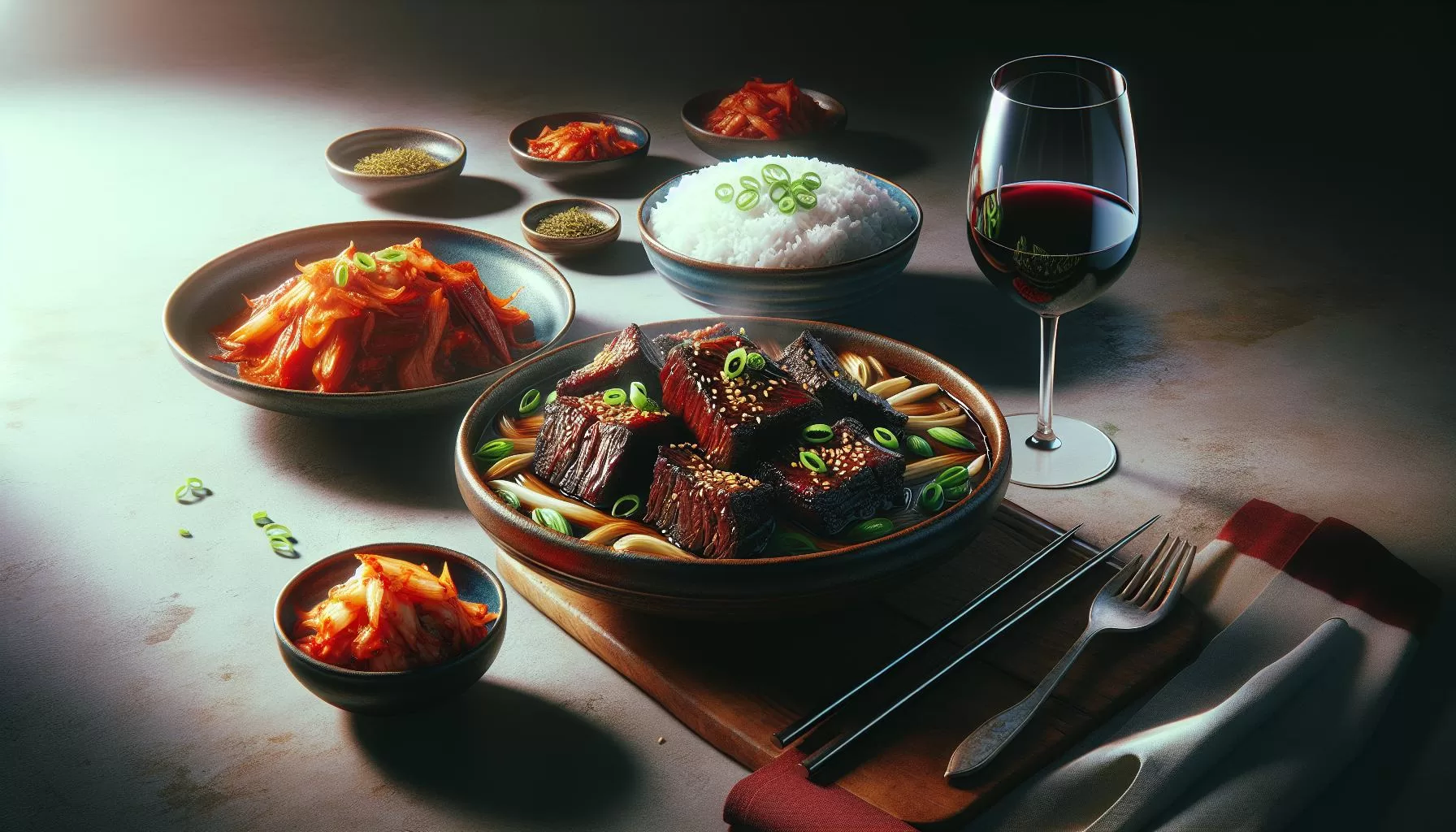
Korea has its own
cuisine, quite different from Chinese or Japanese. Rice is the staple food and a
typical Korean meal consists of rice, soup, rice water and 8-20 side dishes of
vegetables, fish, poultry, eggs, bean-curd and sea plants. Most Korean soups and
side dishes are heavily laced with red pepper. Dishes include kimchi
(highly spiced pickle of Chinese cabbage or white radish with turnips, onions,
salt, fish, chestnuts and red pepper), soups (based on beef, pork, oxtail, other
meat, fish, chicken and cabbage, almost all spiced), pulgogi (marinated,
charcoal-broiled beef barbecue), Genghis Khan (thin slices of beef and
vegetables boiled at the table) or sinsollo (meat, fish, eggs and
vegetables such as chestnuts and pinenuts cooked in a brazier chafing dish at
the table). Other examples of local cuisine are sanjok (strips of steak
with onions and mushrooms), kalbichim (steamed beef ribs), fresh abalone
and shrimps (from Cheju do Island, served with mustard, soy or chilli sauces)
and Korean seaweed (prized throughout the Far East). There is waiter as well as
counter service. Most major hotels will offer a selection of restaurants,
serving Korean, Japanese and Chinese cuisine or more Western-style food.
Drink: Local
drinks are mostly made from fermented rice or wheat and include jungjong
(expensive variant of rice wine), soju (like vodka and made from potatoes
or grain) or yakju/takju (cloudy and light tan-coloured) known together
as makkoli. Korean beers are Crown and OB. Ginseng
wine is strong and sweet, similar to brandy, but varies in taste according to
the basic ingredient used. The most common type of drinking establishment is the
Suljip (wine bar), but there are also beer houses serving well-known
European brands.
Events
Jan 1-2 '01 New Year. Feb 15-17 Lunar New Year. Mar 1
Independence Day. Apr 5 Arbor Day. May 5 Children's Day. May 22
Birth of Buddha. Jun 6 Memorial Day. Jul 17 Constitution Day.
Aug 15 Liberation Day. Sep 23-25 Thanksgiving. Oct 3
National Foundation Day. Dec 25 Christmas Day. Jan 1 2001 New
Year. Feb 3-5 Lunar New Year. Mar 1 Independence Day. Apr 5
Arbor Day. May 5 Children's Day. May 18 Birth of Buddha. Jun 6
Memorial Day. Jul 17 Constitution Day. Aug 15 Liberation Day.
Sep 23-25 Thanksgiving. Oct 3 National Foundation Day. Dec
25 Christmas Day.
SPECIAL EVENTS: Korea celebrates many annual festivals throughout the
year. The most significant festival is Buddha's Birthday in which the 'Feast of
Lanterns' is performed in Korea's streets. Of great importance are the annual
village rituals which are nationally recognised. At these festivals, mountain
spirits, great generals and royalty of the past are remembered and celebrated;
there are festivals that mark the changing seasons and festivals of prayer for a
good harvest. All festivals are characterised by processions, by masked and
costumed local people, music, dancing, battles and sports, to recreate the
original historic event or to conjure up good spirits. Some of the major
festivals and events for 1999 are listed below. Contact the Korea National
Tourism Organization for more details and exact dates.
Jan 24-29 '01 Taekwalryong Snow Festival, Yongpyong ski resort,
Kangwon-do province. Feb Samil Independence Festival, Yongsan.
Mar Myong-dong Festival, Seoul. Mar 5-8 Chongdo Bull
Fighting, Kyongsanbuk-do province. Mar 17-21 Traditional Korean
Liquors and Rice Cake Festival, Kyongju, Kyongsangbuk-do province. Apr
King Tanjong Festival, Yongwol; Cherry Blossom Festival,
Chinae; Chindo Yongdung Festival (Korea's Moses Miracle), Chindo
Island. Apr 9-12 Yongam Dr Wang-in Festival, Chollanam-do
province. Apr 16-18 Chindo Yongdung Festival, Chollanam-do
province. Apr 27-May 5 Soochon Moshi Ramie Cloth Festival,
Chungchongnam-do province. Apr 30-May 19 Yoju Ceramic Festival,
Kyonggi-do province. May Royal Shrine Rites, Seoul. May
21-26 Namwon Chunhyang Festival, Namwon, Chollabuk-do Province.
Jun (4 days) Muju Firefly Festival, Chollabuk-do province;
Andong Folk Festival, Andong. Jul Cheju
International Triathlon, Cheju. Aug Korea International Food
Festival, Seoul. Aug 29-Sep 2 The 8th Asian Congress of
Nutrition. Sep Myong-dong Festival, Seoul; Ginseng
Festival, Kumsan. Sep 11-Oct 30 International Travel EXPO '99,
Kongwon-do province. Oct Ceramics Festival, Ich'on; Shilla
Cultural Festival, Kyongju; Halla Cultural Festival, Cheju. Nov
Kaech'on Art Festival, Chinju.
PASSPORTS: Passport valid for a minimum of 6 months required by all.
VISAS: Required by all except:
(a) 1. nationals of countries mentioned in the chart above for stays
of up to 90 days (except nationals of Canada for stays of up to 6 months and
nationals of Italy and Portugal for a stay of up to 60 days);
(b) nationals of Antigua & Barbuda, Bahamas, Bangladesh, Barbados,
Bulgaria, Colombia, Costa Rica, Czech Republic, Dominica, Dominican Republic,
Grenada, Haiti, Hungary, Iceland, Israel, Jamaica, Liberia, Liechtenstein,
Malaysia, Malta, Mexico, Morocco, New Zealand, Nicaragua, Norway, Pakistan,
Paraguay, Peru, Poland, Romania, St Kitts & Nevis, St Lucia, St Vincent
& the Grenadines, Singapore, Slovak Republic, Surinam, Switzerland,
Thailand, Trinidad & Tobago and Turkey for stays of up to 90 days;
(c) nationals of Lesotho for stays of up to 60 days;
(d) nationals of Tunisia for stays of up to 30 days;
(e) 2. nationals of most other countries are allowed to stay for a
maximum of 15 days without a visa for touristic purposes provided holding a
confirmed return ticket. There are however some exceptions. For details, contact
the Consulate (or Consular section at Embassy).
Note: There are additional visa exemptions for the following
categories: business, touristic visits, meetings, medical treatment, lectures,
games and contests, performances, location shots and cultural exchange. For full
details, contact the Consulate (or Consular section at Embassy).
Types of visa: Tourist/Visit, Transit and Business. For short-term
employment visas and visas for teaching foreign languages in the Republic of
Korea, enquire at the Consulate (or Consular section at Embassy).
Validity: Up to 3 months from date of issue.
Cost: ??19.40 (for single-entry Tourist, Business or Transit visa).
Some nationals are issued visas free of charge. Check with the Consulate (or
Consular section at Embassy) for details.
Application to: Consulate (or Consular section at Embassy). See
address section for details.
Application requirements: (a) Passport with at least 6 months
remaining validity. (b) Completed application form. (c) 1-2 passport-size photos
(depending on nationality of applicant and purpose of visit). (d) ??19.40 fee,
payable by cheque, postal order or cash. (e) Business visas require a letter of
invitation from the host company in the Republic of Korea and a letter on headed
notepaper from the sponsoring company clearly indicating the nature of business
in the Republic of Korea, the intended period of stay and a contact address and
phone number in the Republic of Korea. (f) Stamped, self-addressed envelope if
applying by post. Allow a further week for return of documents.
Working days required: 3 (short stay); 4-8 weeks (work and residence).
Temporary residence: Applications for a residence certificate or for a
stay of more than 90 days should be made to the Immigration Office in Seoul. For
details contact the Consulate (or Consular section at Embassy). See address
section.
AIR: The Republic of Korea's national airline is Korean Air
(KE).
Approximate flight times: From London to Seoul is 11 hours; add
1 hour if flying to any other main city.
From New York to Seoul is 17 hours 40 minutes (including stopover in
Anchorage), from Los Angeles is 10 hours 30 minutes and from
Sydney is 9 hours.
International airports: Seoul (SEL) (Kimpo) is 17km (10 miles) from the
city. Coaches depart to the city every 8 minutes from 0530-2140 (travel time ?
. 50 minutes). Buses depart every 5 minutes. Subway line No. 5 runs to the city
centre (travel time ? . 40 minutes). Taxis to the city are also available.
Airport facilities include: currency exchange, pharmacy, children's restroom,
post office, gift shop, duty-free shop, car hire, local products shop and
restaurant.
Pusan (PUS) (Kim Hae) is 27km (17 miles) from Pusan in the far south.
The airport receives flights from Tokyo, Osaka and Fukuoka. There are bus, coach
and taxi services to the town. Airport facilities include currency exchange,
post office, duty-free shop, snack bar, gift shop, restaurant, travel
information service and car hire.
Cheju (CJU) (Cheju). Buses and coaches are available to the town.
Airport facilities include currency exchange, post office, duty-free shop, snack
bar, gift shop and travel information service.
Departure tax: W9000.
SEA: International ports are Pusan (in the far south) and Inchon (due
west of Seoul). Passenger lines are Pukwan Ferry and Orient Overseas
Lines. Cargo/passenger lines include American Mail and American
President. Crossings from Japan can be made via Pukwan ferry (Pusan? .
Shimonoseki). Three weekly trips from the USA are offered by Lykes
Lines and American President Lines. Knutsen Lines run services from
Australia.
RAIL/ROAD: There are no rail or road links
with the Democratic People's Republic of Korea across the Republic of Korea's
only land frontier. However, this may change in future as the border is to be
opened gradually, starting with foreign visitors travelling in organised
groups.
.