|
DINING IN JAPAN Eating Scenarios for Westerners

Scenario 1

Tom was at the dinner table for the first time with his new host family.
His host mother, Mrs. Yoshida, was a good cook, and there was plenty of food
on the table. Tom enjoyed the meal as well as the pleasant conversation. He
ate so much that he felt absolutely stuffed. When he said, "Totemo oishikatta
desu. Gochisoosama deshita." (It was delicious. Thank you for the meal."),
both host parents insisted that he eat more, saying, "Mada takusan arimasu kara,
motto doozo" (There is plenty more, so please eat more.") Tom declined their
offer very politely by saying he had had enough, but they insisted again. Tom
was dismayed but he felt hesitant about resisting their offer. He put more food
on his plate and finished it somehow.
Why did Tom end up eating more than he wanted?
- A.
- It is customary in Japan for hosts to insist on their guests’ taking more.
Tom didn’t have to eat extra food if he didn’t want any more.
- B.
- It is a Japanese custom to finish all the food on the dinner table.
Tom’s host parents wanted him to have his share since there was still so
much food left.
- C.
- Tom’s pronunciation was clumsy. His host parents didn’t understand what
he said.
- D.
- Tom should have automatically declined the
offer of more food repeatedly (even if he were still hungry!). In Japan,
guests never eat "seconds"; when offered more food, Japanese people
always firmly but politely decline.
Scenario 2
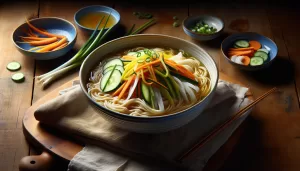
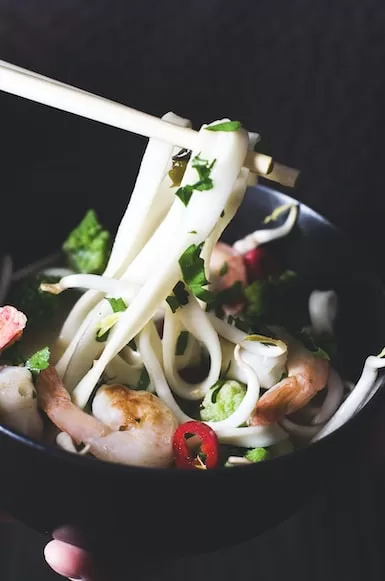
Liz enjoys living in Japan, and she loves Japanese food. Japanese noodles
are her favorite. She often has lunch at a small noodle restaurant near her
downtown Tokyo apartment that’s owned by a well-known soba (buckwheat noodle)
chain. She likes the place because the food is good, the price is reasonable,
and the atmosphere is pleasant. But one thing bothers Liz: the customers
slurp their noodles. Liz thinks of Japanese people as polite and refined, so
it’s difficult for her to reconcile this image with the terrible manners of
the noodle restaurant’s customers.
What’s going on here?
- A.
- Japanese noodle-eating etiquette is, to Americans, unusual to say the least.
In fact, Liz herself should learn to make the same noise and pick up her
bowl to drink the soup that remains after the noodles have been slurped.
- B.
- Liz actually stumbled into a Taiwanese restaurant.
- C.
- This occurrence demonstrates a Japanese double standard: Japanese usually
have beautiful manners only when foreigners are watching.
- D.
- Liz is neurotic. In the United States, the
sound of crackers crumbling has the same effect on her.
ANSWERS to Scenario 1
A.- Correct! It is considered good manners for guests not to accept an offer
at first. Therefore, hosts try to repeat an offer until they are sure that
their guests really want to decline. Tom could have refused their offer
politely by saying, "Arigatoo gozaimasu. Demo moo onaka ga ippai desu kara...."
("Thank you, but I’m already full."), without hurting their feelings.
- B.
- Although there may be countries that have this custom, Japan does not.
Choose again.
- C.
- Possible, but unlikely, because Tom and his host family enjoyed their
conversation so they must have understood each other. Choose again.
- D.
- Incorrect. It was fine for Tom to have an extra
serving after his hosts offered it, if he had been still hungry.
ANSWERS to Scenario 2
- A.
- This is right. What is acceptable in one culture may be very rude in
another. To Japanese people, slurping noodles and picking up the bowl to
drink the soup are not offensive. In fact, many Japanese are dismayed
when Westerners eat noodles noiselessly.
- B.
- Wrong. Read the episode again; it’s a Japanese noodle shop.
- C.
- Not so - at least for noodle-eating! (Liz was certainly noticed in such a
small restaurant.)
- D.
- Highly improbable. If Liz were that neurotic,
she wouldn’t have the sense of adventure and emotional flexibility
required for Americans to enjoy Japan. Try again.
Common Dinner Menu in Japan
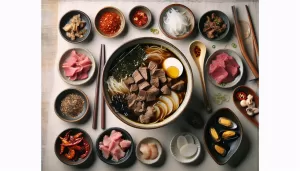
Dishes are prepared as close as possible to the vegetables and fish in season. The menu consists of the usual following dishes:

- boiled rice (gohan)
- suimono or clear soup; misoshiru or miso soup
- nimono, or boiled foods (boiled vegetables, fish or meat)
- yakimono or agemono or both (broiled or deep-fried vegetables, fish or meat)
- sunomono (vinegared vegetables, fish or shellfish)
- aemono (dressed vegetables, fish or shellfish) or hitashimono (boiled greens in soy sauce)
- sashimi (sliced raw fish)
- koonomono (pickles)
Fun Facts about Munching
JAPANESE RESTAURANT FACTS[Barr, p.57-58]
- Japanese diner-outs are almost exclusively male. They never drink sake (rice wine)
and eat rice at the same time. Sake etiquette allots one small bottle of hot wine for
each person, but you never fill your own cup. The cup is held in the hands with
anticipation when sake is being poured. Most Japanese drinks whiskey instead of sake,
anyway.
- Typical Japanese cuisine will proceed from pickled (sunomo) to raw fish (sashimi),
to boiled (clear soup), to simmered (tofu with potato), to grilled (marinated beefsteak),
to fried (tempura), and finish with fruit (snow pear sprinkled with parsley).
- In fact, specialized cuisines such as kaiseki (tea ceremony food) and shoojin ryoori
(temple food) are partaken by mainly rare foreigners, rarer even for the Japanese of this
generation [Richie, p.7].
- The Japanese prefer to end the meal with tiny
pieces of fresh fruits, instead of desserts. The fruit is beautifully
served and often carved into intricate shapes.
* Scenario 1 and Scenario 2 are transcribed from Japanese Cultural Encounters - p.28 & p.36, respectively.
{WebPage Resource for Prof. Gunji (EALC 150) in collaboration with Marcie Dueber / Maintenance by Simpson Leung 12/12/97}
|