Think Peace (2109 bytes)
asiarecipe.com logo (18125 bytes)
Japan
Japanese flag (10295 bytes)
Current time in Japan

Western / Japanese Dining Etiquette

Pre-set dinner settings and utensils upon arrival
  • On the person’s left are: 3 forks (salad, dinner, & dessert)
  • On the person’s right are: 2 spoons (soup & tea) and 1 butter knife
  • Folded individual napkin :
  • On lap signifies you’re beginning to dine
  • On chair signifies you’re excusing yourself from the table
  • On table signifies you’re done with your meal

    In a restaurant, to signal to the wait person that you’re done, cross your knife and fork on the dinner plate

    Rude to slurp your soup or belch; also, scoop the spoon away from you

    Wait until everyone is served a meal before commence eating

    Avoid eating too fast so that everyone can finish roughly the same time

    Chew with your mouth close

    Never reach over someone else’s plate

    Avoid getting off your seat to reach a dish at a far end of the table; it is more preferable to politely ask a neighbor to pass the desired dish


    EASTERN DINING
    Unique Dinning Etiquette of Japan

    Japanese dishes are served either on the table for all the dinner company present or separately for each guest, set on a small, square meal-tray. Other notable dinner etiquette applicable during a Japanese meal are

    The lid of the rice bowl is placed upside down outside of the tray to the left. Soon afterward, the lid of the soup-bowl should be placed on the guest’s right. When eating politely, it is proper to put the bowl of food on the left palm.
    A second helping of rice or soup may be served on a separate tray by the host. The guests must warmly accept the bowl with both hands, taking care to put it down on their trays once before beginning to eat from it again.
    A morsel from a dish should be followed by a mouthful of rice.
    As a rule, no napkins are used in a Japanese meal. The guest uses either a paper or handkerchief he has with him.
    At the end of the meal the tips of the chopsticks are dipped in tea poured into the empty rice-bowl and then wiped off on a clean piece of paper. All the lids are replaced.
    The guest says, "Gochisoo sama" with a bow. This concludes the dinner at a Japanese house.

    EASTERN DINING
    Manipulation of Chopsticks in Japan

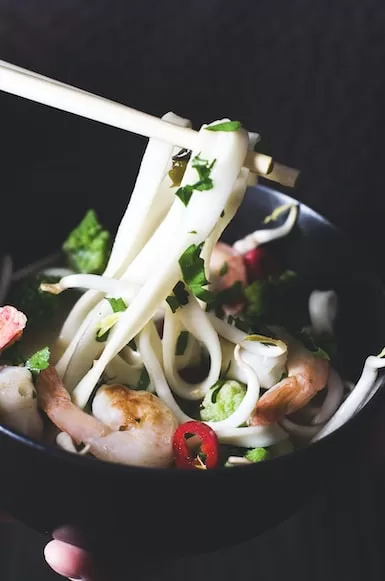
    Chopsticks should be placed on the table pointing to the diner’s left, with the tips resting on the ‘hashioki’. Take the chopsticks in your right hand and transfer them to the left hand. Then take the proper grip on them with the fingers of the right hand.


    DO NOT use your chopsticks to shift dishes around

    DO NOT wave your chopsticks about in the air while trying to decide what to eat next

    DO NOT rummage about in the food looking for the tastiest morsel

    DO NOT pick up a dish with the hand that is holding the chopsticks

    DO NOT point your chopsticks at people when you are eating; never lick them or spear food with the points

    DO NOT hold the chopsticks with your fist, since this appears as if they are being held as a weapon to hurt people
    Chopsticks Etiquette
    A Visual Representation of the Rules Above

    Also, put the chopsticks on the chopstick rest when not in use. This offers a convenient position to rest your eating utensils without worrying about unclean surfaces making contact with the points. Generally available at the more expensive or classier dining rooms.


    Other Differences
    Table Manners of Japan


    1.Westerners are often taught not to make a noise when eating soup, whereas, in Japan it’s okay to slurp one’s noodles


    2.Don’t start eating the soup as soon as it is placed in front of you, because Japanese meals are usually served all at once, rather than as separate courses, so wait until all the food is on the table and everyone is ready before you begin


    3.Vertical planting of hashi in rice bowl reflects how rice is offered by Buddhists to their deceased ancestors. This is a sign of mourning for the dead.


    4.Before starting a meal, say "Itadakimasu"; after finishing, say "Gochisoosama."
    On the other hand, it is common in American culture for traditional families to say a word of grace and thanksgiving before commencing dinner. It ranges from a prayer of love and thanks to God for His provisions, blessings, and grace over the food to the less tactful saying, "Rubber dub-dub, thanks for the grub."

    {WebPage Resource for Prof. Gunji (EALC 150) in collaboration with Marcie Dueber / Maintenance by Simpson Leung 12/12/97}


    Afghanistan  Bangladesh  Bhutan  Brunei  Burma Cambodia  China  India  Indonesia  Japan   Korea  Laos   Malaysia  Mongolia  Nepal  Pakistan  Philippines Singapore  SriLanka Thailand   Tibet    Vietnam
    All proceeds from donations, book, and banner sales go to support education for children in Northern Thailand
    Privacy Policy | FAQ
    copyright 1999-2002 asiarecipe.com
    You can also donate to help us to continue to provide our services
    Thanks for your support.
    Clicking on these ads helps provide funds and scholarships to poor students at
    Pongyang Elementary School in Chiang Mai, Thailand.
    The children there thank you for your support.
    And so does AsiaRecipe.com...
    We know banners can be annoying at times,
    but we hope you will appreciate the good your support does.
    Thanks for your patience.
    For World Peace