A unique Chinese food is dim sum. Actually dim sum
is more than just a category of dishes; it's an eating habit.
Dim sums are small dishes taken for snacks or tea time (in Chinese:
yam cha); they are served in restaurants on a trolley.
Most of the dim sum dishes are steamed, but they may also be fried
or braised. Common to all dim sums is that they are in small portions, bite size, and normally strongly flavored. Dim sum is of Cantonese
origin and very popular not only in China but also in other Asian countries
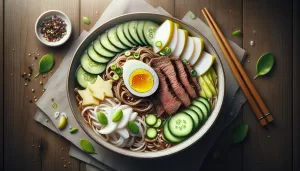
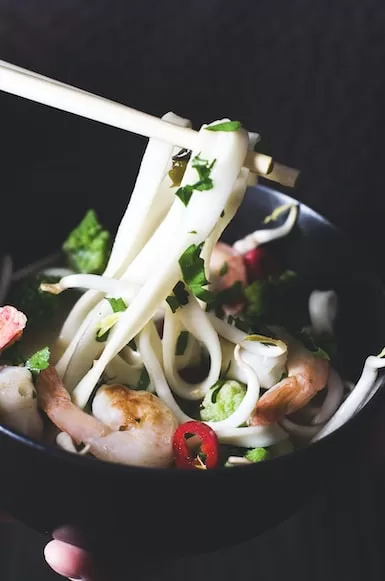
Noodles occupy an important
position in Chinese cuisine. Actually, the Chinese were the inventors
of noodles, and they were brought to the European noodle country,
Italy, by Marco Polo only in the 13th century.
Unlike the Italians, who can't explain why their spaghetti
are impractically long, the Chinese do have a seemingly very logical
reason why the longer the noodles are the better; to the ever
superstitious Chinese, long noodles mean long life.
Making noodles the traditional Chinese way is an acrobatic art.
The dough is pulled and whirled through the air in order to stretch
it through centrifugal force; but today machines use other techniques.
There are two kinds of noodles in Chinese cuisine, egg noodles
or mien, and rice noodles or bijon (in English sometimes
referred to as glass noodles because they just look like they
were made of glass). Whereas egg noodles are mostly in the shape
of thin spaghetti, rice noodles are also commonly served as ho
fan (wide noodles like the Italian fettuccine and tagliatelle).
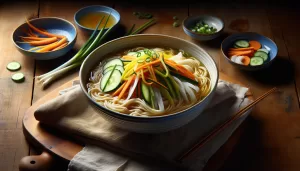
In Chinese cuisine, noodles can be served three ways: in a clear
soup with meat and some vegetables, or mixed with meat and with
a thickened sauce poured over or without sauce; whereas for noodles
with sauce egg noodles (mien) are commonly used, it's bijon
noodles if served without sauce.
Egg noodle dishes with sauce appear on Chinese menus with English
translations often specified as fried. This is grossly
misleading as they are mostly just barely sauted. There is nothing
crisp in such a "fried" dish, and the rather tasteless
cornstarch sauce gives the dish a porridge texture.
Those who want to eat dishes that are fried by Western standards
must order deep-fried dishes in Chinese English terminology.
Deep-fried dishes include spring rolls, shrimp, and prawns.
Except for the already mentioned clear soups with noodles, there
also are many thickened soups in Chinese cuisine. The thickening
is produced normally from cornstarch. Like clear soups the thickened
soups may contain meats, fish, seafood and vegetables. In contrast
to Western cuisine, Chinese cooking commonly uses lettuce in soups
but not in salads.
The two most famous Chinese soups, shark fin soup and bird's
nest soup appear to be thickened but the glutinous texture
does, in neither case, result from the addition of cornstarch but
from the two main ingredients, shark fin and bird's nests which
are simmered for many hours.
As the Chinese are the only people who can make sensible use
of shark fins they are exported by Chinese traders to countries all over the world.
The nests in making bird's nest soups are exclusively those of
swallows. They are built by the birds mainly of sea weed
that is cemented together by their own saliva. Swallow nests are
mainly found on high cliffs in areas along the Southern Chinese
coast.
The Chinese term for swallow nests is ni do. A rich
area for bird's nests is Northern Palawan in the Philippine archipelago.
There is a town famous for its cliffs has been baptized
in honor of the bird's nests: El Nido.
As rice is processed into noodles, another common Chinese agricultural
product, soy beans, is processed into bean curd.
Bean curd didn't make it as far as Italy. It was, however, also
integrated into other asian cuisines. Bean curd (in Chinese: to kua)
accompanies original Chinese meals as normally as potatoes accompany
German dishes (where they are not taken as vegetables).
Bean curd,commonly known as tofu the Western world, has the appearance and
texture of soft cheese and is produced by milling soy beans
and forming large cakes of it that can be stored for quite a while.
It can be cut into slices, and as it is fairly tasteless by itself
(just as noodles), it easily adopts the taste of sauces and the
other ingredients of a dish.
A by-product of bean curd which has a less stable texture
(like thickened milk) is commonly sold in Asia by ambulant
vendors as a dessert or morning drink. They walk through the streets, equipped with two large
aluminum baskets, the one containing the sweet bean curd milk,
and the other some sauces, syrups, and other toppings.
Prominent as noodles may be in Chinese cuisine, the most basic
staple food is rice. The Chinese word for rice is fan (remember
the ho fan - wide rice noodles).
To serve food in portions for a single person
is very untypical of Chinese dining habits. Usually, the side
dishes to rice are not served individually but family style
with large plates placed in the center of a table. This eating
order is still strongly reflected in the way Chinese restaurants
are furnished. Often there is inadequate space for people who
come alone or in pairs. Mostly large round tables can be seen,
with a round board in the middle that can be turned so everyone,
using the chopsticks, can help himself or herself to a few bites
from every plate.
It's commonly known that the Chinese invented chopsticks
as a set of instruments to be used when eating but the reason
behind that is not commonly known. Actually, the Chinese were
taught to use chopsticks long before spoons and forks were invented
in Europe (the knife is older, not as an instrument for dining
but as weapon). Chopsticks were strongly advocated by the great
Chinese philosopher Confucius (551-479 BC).
He reasoned that, as a matter of advancement in civilization,
instruments used for killing must be banned from the dining table.
Therefore, knives cannot be permitted, and that is why Chinese
food is always chopped into bite size before it reaches
the table.
Chinese cooking is not complicated in the manner that French
cuisine is complicated. Much less depends on temperatures of ingredients
and exact timing for frying, baking, or cooking. Most Chinese
dishes are just cooked in water or oil. Of course, there are many
delicacies but most of them do not require such an elaborate processing
in the kitchen as does one of China's most famous dishes, Peking
duck (thin slices of barbecued duck, wrapped in thin pancakes
together with onion, radish, etc and eaten with a sweet plum sauce).
But while Chinese cuisine may not beat French cuisine in the degree
it is complicated to prepare dishes, Chinese cuisine certainly
wins the prize for stranger ingredients.
Now, while the French have their strange and hard to find ingredients
like truffles, they cannot come up with an ingredient like
the previously mentioned bird's nests.
The Chinese have a refreshingly unemotional approach to edibles.
One may think that as long as eating something doesn't cause a
disease there must be a way it can be prepared deliciously.
Therefore, birds nests are not the only strange food stuff used
in Chinese cuisine. Others include sea weeds, shark fins, sea cucumbers,
etc. There are no forbidden foods like pork in Islamic
countries and beef for Hindus. On the contrary, many foods are
recommended in the Chinese cuisine for a variety of medical
purposes, several of them to restore sexual power.
This goal, for example, allegedly is achieved by consuming Soup
No 5 which contains the testicles of various animals.
Many animals with a phallic look are also supposed to help
men's sexual power, as for example eel and snake. Snake meat
is highly valued in Chinese cuisine rather for a number of alleged
pharmaceutical effects than the taste (it tastes like chicken).
Snake is supposed to be particularly good in winter because it
is regarded as heart warming. Eating the snake's gall bladder
is supposed to bring sure relief from rheumatism. A dish named
Dragon, Phoenix, Tiger is prepared of snake, chicken and
cat and is supposed to be an especially powerful agent to restore
youth and vigor.
Of course there is nothing wrong with eating cats, snakes, and
bird's nests; most probably these foods are even nutritious; it's
just the idea of it that cannot convince Westerners to
enrich their diet with these delicacies. Cats especially, being
considered pets, receive in Western tradition sympathy to a degree
that is never afforded less cute animals such as pigs or chickens.
Furthermore, what criteria makes some kinds of animals a clean
food and others unacceptable to the Western diner are just perceptions
based on ignorance. Shrimp live in mud and preferably near
sites where waste is drained into the sea, and those who believe
chickens only eat clean food may observe them pecking on dung-hills.
Who, after these elaborations, doubts that the Chinese have a more
enlightened approach to food than Westerners....:)
China is a vast country and it is therefore no surprise that there
are many regional variations in Chinese cuisine. In general,
one can say that the Southern Chinese Cantonese, cuisine
puts more emphasis on fish and seafood and the Northern Chinese
Peking, cuisine includes more meat. Of all meats, pork is
most common in all Chinese cuisines. Actually the pig is so respected
by the Chinese that the Chinese character for "home"
is a combination of the characters for "roof" and "pig".
The central Chinese regions of Sichuan and Hunan
have the spiciest food in all of China. Garlic as well as chili
are extensively used.Chairman Mao, who was Hunanese,
once claimed that the more chilies one eats the more revolutionary
one becomes. It was meant as a joke (most probably) but the statement
is in accordance to the Chinese belief that diet makes a great
difference in the well-being of a person. Anyway, Mao Zedong's
theory fails to explain why other cultures who certainly eat loads
of chili are in general rather more conservative than revolutionary.
In the case of exclusive dining, Chinese have a different
orientation than Westerners. First, the ambience of a restaurant
is much less important; even first-class Chinese restaurants tend
to be simply and inexpensively furnished. Second, unlike European
custom, a dish doesn't become much more expensive when prepared
by a much better cook.
In Europe, a certain meal (for example baked duck) can cost
many times as much in an exclusive restaurant than it does in
an ordinary restaurant; in the case of Chinese restaurants it's
less the particular preparations that make a restaurant first-class
but more the use of fancy and more expensive foods.
An exclusive Chinese restaurant for example will serve foods like
abalone (a large marine snail; only the foot, about
fist size, is served) which can cost $50 and up per dish.
But it's not the preparation that makes these foods so expensive,
it's just the price of the raw material. Many more ordinary
Chinese dishes do not cost much more in first-class Chinese restaurants
than they do in plainer kinds.
Tea is preferred by the Chinese as a drink during all meals
less for it's own taste but to clear the palate of a former dish
before proceeding to the next. And as proclaimed by the Hong Kong
Tourist Association in their official guide, "the Chinese
don't ruin the tea with such alien substances as milk, sugar or
lemon."
A typical addition to the names of Chinese restaurants is Garden.
Usually, Chinese restaurants designating themselves as Gardens
are better class.
You can also donate to help us to continue to provide our services Thanks for your support.
Clicking on these ads helps provide funds and scholarships to poor students at Pongyang Elementary School in Chiang Mai, Thailand. The children there thank you for your support. And so does AsiaRecipe.com...
We know banners can be annoying at times, but we hope you will appreciate the good your support does. Thanks for your patience.